Tea Ceremony
Spanning centuries of cultural evolution, the Chinese tea ceremony embodies tradition, philosophy, and the refined art of tea.
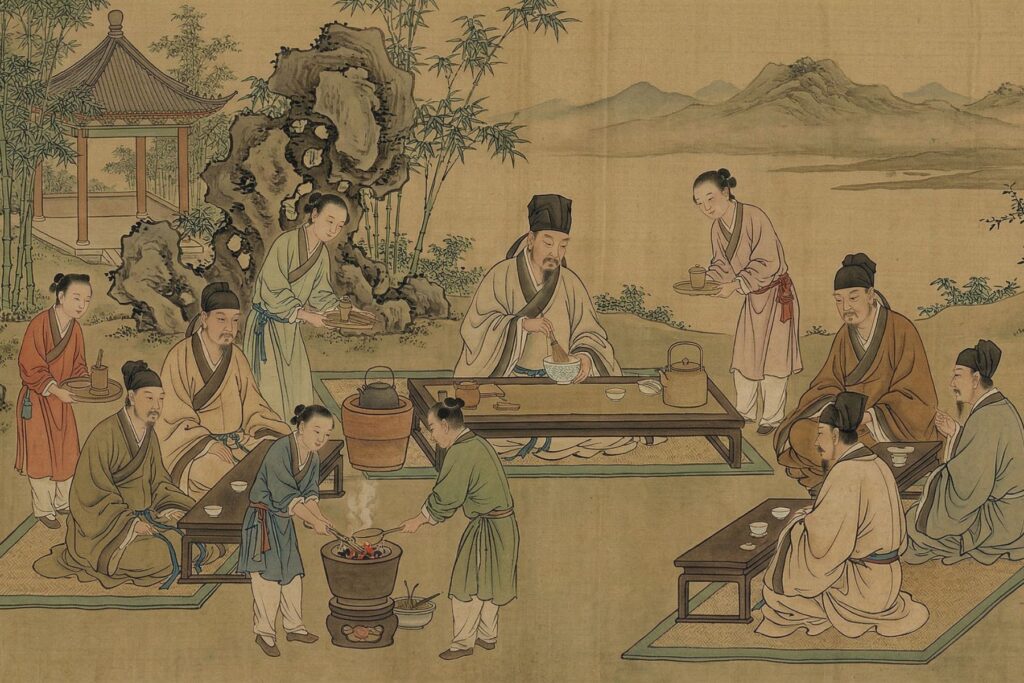
The Chinese tea ceremony is a traditional cultural practice that reflects the philosophy, aesthetics, and social values of Chinese civilisation. Rooted in centuries of history, it is more than simply preparing and drinking tea—it is an art form that embodies harmony, respect, purity, and tranquillity. Practised in both formal and informal settings, the ceremony highlights the deep connection between nature, mindfulness, and human interaction.
Subject Area
Tea Culture, Ritual Practice, and Material Culture
Traditions
Chinese
Period
Ancient China (c. 7th Century) – Present
Overview
From Medicine to Cultural Practice
The origins of tea as a plant known and used by human beings in China extend into prehistoric time. Legend attributes its discovery to the mythological emperor Shennong (神農) — the Divine Farmer — who, according to later accounts, accidentally ingested a tea leaf while boiling water and found it restorative. While this foundation story belongs to myth rather than verifiable history, it encodes a real insight: tea’s earliest documented uses in China were medicinal rather than social or aesthetic.
By the Han dynasty (206 BCE–220 CE), the character 茶 (chá) — the word for tea as we know it — had entered written Chinese, replacing an earlier character 荼 (tú) used for bitter plants more broadly. Tea appears in Han texts as a tonic and stimulant, and by the fourth century CE its perceived medicinal virtues had acquired the force of general belief. Buddhist monks found tea valuable for maintaining alertness during long periods of meditation — an association that would prove consequential for the subsequent transmission of tea culture across East Asia.
“To quench thirst and dryness, water is imbibed; to alleviate sorrow and annoyance, wine is guzzled; to relieve fatigue and drowsiness, tea is sipped.”
Lu Yu — The Classic of Tea (茶經), 760 CE
By the time of the Tang dynasty, tea had moved well beyond medicine. It was a common beverage across all social classes, a subject of poetry and connoisseurship, and a commodity important enough to sustain a significant trade between tea-producing regions and the cities and frontier territories that consumed it. It was in this context — of tea as both popular beverage and elite cultural practice — that Lu Yu composed his foundational text.
The Foundational Text
Lu Yu and The Classic of Tea
The Classic of Tea (茶經, Chájīng), written by the Chinese scholar Lu Yu between 760 and 762 CE, is the first known monograph on tea and tea culture in the world. Its composition marks the moment at which tea preparation became, in China, a subject worthy of sustained intellectual treatment — something to be theorized, ranked, systematized, and discussed with the seriousness previously reserved for calligraphy, painting, or classical scholarship.
Lu Yu (733–804 CE) was an orphan raised in a Buddhist monastery, who — in a biographical arc characteristic of the Tang literati imagination — fled monastic life to join a travelling theatrical troupe before eventually finding his place among the scholarly elite as a friend of calligraphers, poets, and officials. His obsession with tea was lifelong and total: he spent years travelling through tea-producing regions, studying cultivation, processing, water sources, and preparation methods. The Classic of Tea is the record of that accumulated knowledge, written in the compressed, refined literary Chinese of the Tang.
Structure of the Classic of Tea
Lu Yu and The Classic of Tea
The text covers, in ten chapters: the origins and botanical nature of the tea plant; the fifteen tools required for processing tea; the methods of production (picking, steaming, pressing, drying, storing); the twenty-eight utensils for preparation and serving; the art of boiling water and its three stages; the procedures for making tea; the historical record of tea in Chinese literature; tea-producing regions ranked by quality; when simplifications of equipment and method are acceptable; and finally, a recommendation to transcribe key passages onto scrolls for daily reference.
What makes the Classic of Tea more than a technical manual is its insistence on the relationship between material quality and spiritual cultivation. Lu Yu believed that the proper preparation of tea was not merely a matter of taste but of character — that attention to water, fire, vessel, and leaf was a form of moral as well as aesthetic discipline.
As the preface to one edition summarizes: “Before Lu Yu, tea was rather an ordinary thing; but in a book of only three parts, he has taught us to manufacture tea, to lay out the equipage and to brew it properly.” Tea sellers of his own time reportedly made pottery statues of Lu Yu and offered them veneration; he was posthumously elevated, in popular culture if not in official ritual, to the status of patron deity of tea. His legacy shaped the subsequent development of tea culture in China, Korea, Japan, and beyond.
A Millennium of Change and Refinement
The history of tea culture in China is not a single continuous tradition but a sequence of distinct practices — each shaped by the social, political, and aesthetic priorities of its era — in which the form of tea itself (compressed cake, powdered, loose leaf) and the manner of its preparation changed substantially across the dynasties.
Tang Dynasty 618–907 CE
Boiled Tea and the Birth of Tea Culture
Tea in the Tang was processed into compressed cakes — dried and bound — which were broken, ground into powder, and boiled in water. Lu Yu’s Classic of Tea describes this method in detail, including the three stages of boiling water (fish-eye bubbles, string-of-pearls bubbles, and the rolling boil at which powdered tea is added). The Tang period establishes tea as a subject of elite cultural attention — discussed in poetry, theorized in prose, ranked by region and quality, and associated with the values of the literati.
Song Dynasty 960–1279 CE
Whipped Tea and the Aesthetics of Foam
The Song dynasty transformed the practice. Rather than boiling powdered tea, Song drinkers whisked it in a small bowl with hot water, producing a frothy liquid whose visual qualities — the whiteness of the foam, the evenness of the bubbles, the clarity of the bowl beneath — became subjects of intense aesthetic discrimination. The practice of dòucha (鬥茶, “tea competition”), in which participants judged the quality of each other’s whisked tea against precise visual criteria, exemplifies the Song aestheticization of tea preparation. The ceramic tea bowl became an object of connoisseurship in its own right. The finest bowls for whisked tea came from the Jian kilns in Fujian — dark-bodied, with distinctive crystalline “hare’s fur” or “oil spot” glaze patterns that showed off the white foam to best advantage.
Ming Dynasty 1368–1644 CE
Loose Leaf Tea and the Teapot
The Hongwu Emperor’s early Ming prohibition on compressed tea cakes (issued partly for administrative simplicity in the tribute system) had a transformative effect on tea culture: it accelerated the shift to loose-leaf tea steeped in hot water. This change reshaped the entire material culture of tea. The tea bowl gave way to the teapot as the primary vessel of preparation. The Yixing teapot — produced from the distinctive purple, red, and grey clays of Yixing in Jiangsu province — emerged in the sixteenth century and rapidly became the defining object of Chinese tea aesthetics. Its unglazed surface, responsive to repeated seasoning with tea oils, and its variety of carefully considered forms made it a vehicle for the expression of the literati values of simplicity, subtlety, and natural beauty.
Qing Dynasty 1644–1912 CE
Gongfu Cha and Regional Elaboration
The Qing period saw the consolidation and regional elaboration of what would become gongfu cha — the skilled method of brewing tea with a high leaf-to-water ratio, small vessels, and multiple short infusions. Originating in Fujian and the Chaoshan region of eastern Guangdong, this approach was documented by the poet and gastronome Yuan Mei in his Suiyuan Shidan (隨園食單) of 1792, where he described the tea practices of monks in the Wuyi mountains with evident admiration. The first dedicated systematic account of gongfu cha was not published until 1957, by Weng Huidong — a reminder that this regionally specific practice was not universally known across China until relatively recently.
20th Century–Present
Revival, Codification, and Global Spread
The suppression of traditional cultural practices during the Cultural Revolution (1966–1976) disrupted tea culture on the mainland, shifting important centres of practice to Taiwan, Hong Kong, and overseas Chinese communities. In Taiwan, from the 1970s and 1980s, practitioners began codifying what would become the modern form of gongfu cha — drawing on both Chaozhou tradition and Japanese tea aesthetics to produce a systematized, teachable practice. This modern gongfu cha has since spread globally, practiced in tea houses from Beijing to Brooklyn, and increasingly studied as a subject of cultural history, anthropology, and material culture research.
The Practice of Skilled Brewing
Gongfu Cha — 工夫茶
The term gongfu cha (工夫茶 or 功夫茶) — often rendered in English as the “Chinese tea ceremony” — requires careful handling. It is more accurately described as a specialized technique of brewing tea than as a ritualized ceremony in the formal sense. The characters for gongfu translate literally as “skill,” “effort,” “time,” and “art” — conveying a practice defined not by fixed ceremonial steps but by the sustained development of expertise in tea preparation.
The essential features of gongfu brewing distinguish it from ordinary tea preparation: a high ratio of leaf to water; a small brewing vessel (typically a Yixing teapot or gaiwan of between 60 and 200 ml); short infusion times of seconds rather than minutes; and multiple successive infusions of the same leaves, each producing a distinct profile. This method allows the brewer — and the drinker — to experience the full range of a tea’s flavour across its infusions: the brisk, bright notes of the first steep giving way to deeper, rounder qualities in the third, fourth, or fifth.
The Chaozhou Tradition
The oldest and most rigorous form of gongfu cha is associated with Chaozhou (潮州) in eastern Guangdong — a coastal trading city whose prosperity and regional pride supported an unusually refined tea culture. Chaozhou gongfu cha is characterized by extreme precision: very small teapots, very high leaf ratios, very brief steepings, and a formalized set of gestures that govern the pouring, the warming of cups, and the presentation to guests.
The Chaozhou tradition also maintains distinctive material preferences — particularly for the finest Dan Cong oolong teas from the Phoenix Mountain area — and for the small, unglazed red clay teapots of the Chaozhou style, distinct from the Yixing pots more widely associated with gongfu cha elsewhere.
The Scholarly Debate
The identification of gongfu cha as “the Chinese tea ceremony” is historically contested. Scholars have noted that the practice was a regional method, largely unknown outside its home territory until the late eighteenth century, and that even in the early twentieth century it was described by the Fujian writer Lin Yutang as an art “generally unknown in North China.”
The elevation of gongfu cha to the status of representative “Chinese tea ceremony” is, in part, a product of twentieth-century cultural politics — particularly the effort by Taiwanese tea practitioners from the 1970s onward to construct a Chinese cultural identity distinct from both mainland Communist culture and Japanese colonial influence. Modern gongfu cha is, in this sense, a genuinely hybrid practice: rooted in Chaozhou and Fujian tradition but shaped also by Japanese aesthetic influences, Taiwanese cultural politics, and global tea market dynamics.
Material Culture
Implements and Vessels
The material culture of Chinese tea is extensive and historically layered — shaped by the changing forms of tea preparation across the dynasties, by regional traditions of ceramic production, and by the aesthetic preferences of successive scholarly elites. Understanding the objects of tea culture is inseparable from understanding the practice itself.
Historical Masters
The Masters of the Tradition: A Selective Canon
Chinese calligraphic culture is organised, in part, around a canon of exemplary masters whose works have been studied, copied, and venerated for centuries. To learn calligraphy is, in the first instance, to enter into a direct physical relationship with these figures — to trace their strokes, to inhabit their rhythms, to understand from the inside what made their work transformative.
Yixing Teapot
宜興茶壺 — Zisha ware
The defining ceramic object of Chinese loose-leaf tea culture, produced from the distinctive purple, red, and grey clays (zisha) of the Yixing region in Jiangsu province since at least the sixteenth century. Unglazed and fired at high temperatures, a Yixing teapot gradually absorbs tea oils through use, developing a rich patina and — according to long-held belief — contributing its own character to the flavour of the tea brewed within it. The forms of Yixing pots — from the rounded “pear” shape to geometric “square” forms — are studied by connoisseurs as expressions of the literati aesthetic of simplicity, wit, and restrained beauty. Named makers, from the sixteenth-century master Gong Chun onward, are subjects of dedicated scholarship and significant collecting markets.
Gaiwan
蓋碗 — Lidded bowl
A three-piece set — bowl, lid, and saucer — used as both brewing vessel and drinking cup. The gaiwan requires no spout: the lid is tilted to act as a strainer as the tea is poured or sipped directly. Developed during the Ming period and closely associated with the Qing court and its tea culture, the gaiwan is today widely used for gongfu brewing as well as for evaluating teas in the tea trade. Its unglazed interior (in the finest examples) reveals the colour of the liquor without the interference of a coloured glaze.
Fairness Cup
公道杯 — Gongdao bei
A pitcher into which brewed tea is first decanted from the teapot before being distributed to individual cups — ensuring that all guests receive tea of uniform strength and temperature, and that over-steeping is avoided. The fairness cup entered standard gongfu practice in the twentieth century; its name, meaning “cup of justice” or “cup of equity,” reflects its social function as a guarantor of equal hospitality.
Tea Tray
茶盤 — Chápán
A wooden, bamboo, or stone tray with a built-in drainage system, used to contain the water spilled during the warming of vessels and the rinsing of cups. The tea tray is central to the “wet” style of gongfu brewing practiced in mainland China, where generous quantities of water are poured over pots and cups as part of the preparation ritual. The repeated oiling of a wooden tray with spilled tea produces, over years of use, a surface of distinctive warmth and patina.
Jian Ware Tea Bowl
建盞 — Song dynasty
The iconic tea bowl of the Song dynasty whipped tea practice — dark-bodied, with characteristic iron-saturated glaze patterns produced during high-temperature firing: “hare’s fur” (tuháo), “oil spot” (yóudiǎn), and the rarest “partridge feather.” Produced at the Jian kilns in Fujian, these bowls were designed to display the white foam of whisked tea to best advantage against a dark background. They were exported to Japan, where they are known as tenmoku and remain among the most prized objects in the Japanese tea tradition.
Tea Pet
茶寵 — Cháchǒng
A small clay figure — dragon, toad, monk, or other form — placed on the tea tray and “fed” with the rinse water or first infusion during each tea session. Over months and years of this treatment, the unglazed clay develops a rich, even patina that testifies to the accumulated history of tea sessions. The tea pet is an object of affection and mild superstition, and its cultivation — the gradual bringing-out of its surface beauty through repeated use — is understood as a form of the same patient, attentive relationship that good tea itself requires.
Tea Varieties
Six Categories of Chinese Tea
Chinese tea is conventionally classified into six categories according to the degree of oxidation and the processing methods applied to the leaf after harvest. Each category encompasses a range of regional varieties with distinct flavour profiles, growing conditions, and cultural associations. The choice of tea shapes every dimension of the gongfu practice — the vessel, the water temperature, the infusion time, and the number of steepings the leaf will sustain.
Green Tea
Unoxidized, retaining the fresh, vegetal character of the leaf. Processed immediately after harvest to prevent oxidation — typically by pan-firing or steaming. Associated with spring harvests and noted for their delicacy. Examples: Longjing (Dragon Well), Biluochun.
White Tea
Minimally processed — dried slowly with little manipulation. The oldest form of production, associated with Fujian province. White tea’s gentle sweetness and pale liquor make it suited to lower brewing temperatures and long, patient infusions. Examples: Bai Hao Yinzhen (Silver Needle), Bai Mudan.
Yellow Tea
Rare and lightly processed — similar to green tea but with an additional “sealed yellowing” step that mellows the vegetal character. Historically associated with imperial tribute. Now among the rarest categories in Chinese tea production. Example: Junshan Yinzhen.
Odolong Tea
Partially oxidized — ranging from lightly oxidized varieties with floral, green characteristics to heavily oxidized wares approaching the depth of black tea. Oolong is the tea most associated with gongfu cha and the Fujian-Guangdong tradition. Examples: Tie Guan Yin, Da Hong Pao, Dan Cong.
Black Tea
Fully oxidized, producing robust, often malty liquors. Known in China as hóngchá (red tea) for the colour of the infusion. Keemun from Anhui province is among the most celebrated of Chinese black teas and one of the most admired internationally.
Dark Tea (Pu-erh)
Post-fermented and aged — a category unique in its capacity for prolonged development. Pu-erh from Yunnan province can be stored for decades, its flavour deepening and transforming with age. Among the most actively collected and studied of all tea categories. Pu-erh cakes have served as currency along the Tea Horse Road.
Philosophy and Aesthetics
Tea as Spiritual and Intellectual Practice
What distinguishes Chinese tea culture from a mere refined beverage habit is the weight of philosophical and aesthetic thought that has accumulated around it — thought rooted in the three great currents of Chinese intellectual life: Confucianism, Daoism, and Buddhism.
From Buddhism, tea inherited its earliest cultural prestige: the association between tea and meditative alertness, between the discipline of preparation and the discipline of mind. The monastery was one of the earliest sites of serious tea culture in China, and Buddhist monks played a decisive role in transmitting tea knowledge — including the cultivation of specific tea plants — across China and into Korea and Japan. The Zen (Chan) Buddhist aesthetic of simplicity, presence, and attention to the immediate moment found in tea preparation a natural vehicle for its expression.
From Daoism, tea culture absorbed its orientation toward nature — toward the cultivation of sensitivity to natural materials, natural processes, and the character of specific places. The Daoist preference for simplicity, spontaneity, and the avoidance of artifice shaped the Chinese aesthetic of tea wares: the preference for unglazed clay that reveals the natural material, for irregularity that speaks of the hand rather than the mould, for patina that accumulates through use rather than decoration applied in advance.
From Confucianism, tea acquired its social dimensions: the protocols of hospitality and hierarchy, the expression of respect through the care taken in preparation, and the placement of tea within the broader cultural programme of self-cultivation (xiūshēn) through which the Confucian scholar was understood to develop his character.
Literati Culture
Tea in the Scholar's Studio
The most important context for understanding the aesthetic dimension of Chinese tea culture is the literati tradition — the culture of the scholar-official class whose values, tastes, and practices shaped Chinese art history from the Song dynasty onward. For the Chinese literati, tea was not merely a drink but one element within a carefully constructed environment of cultivation: alongside ink stones, brushes, books, bronze vessels, potted plants, and incense, it constituted the material vocabulary of the scholar’s studio (shūzhai).
The production of Yixing teapots became, from the late Ming period, a collaborative enterprise between potters and literati — scholars who designed forms, composed inscriptions, and commissioned pots as vehicles for the expression of taste and intellectual identity. The calligraphy carved into a Yixing pot’s surface, the classical allusion embedded in its form or name, the restraint of its proportions — these were dimensions of meaning as significant as the tea brewed within.
Tea writing — poems, essays, tasting notes, technical treatises — forms one of the most extensive bodies of specialized literature in the Chinese tradition. From Lu Yu’s Classic of Tea through the Song dynasty’s proliferating tea competition manuals to the Ming literati’s essays on the cultivation of taste, this literature demonstrates that tea was understood as a subject demanding the same seriousness of attention that scholars gave to painting, calligraphy, or classical texts.
Transmission and Global Influence
Tea Beyond China
Tea culture transmitted from China outward through two primary channels: Buddhist monasticism and commercial trade. Buddhist monks carried knowledge of tea cultivation and preparation to Korea, Japan, and Vietnam from as early as the seventh century CE. The Japanese tea ceremony (chanoyu), which would develop its own distinct aesthetic philosophy under the influence of Zen Buddhism and the tea master Sen no Rikyū in the sixteenth century, has its roots in the whipped tea (matcha) culture of the Chinese Song dynasty — transmitted to Japan by the monk Eisai, who brought tea seeds and Song tea practices from China in 1191.
Commercial trade along the ancient Tea Horse Road (chámǎgǔdào) — the network of mountain paths connecting Yunnan’s tea-producing regions with Tibet, India, and Central Asia — was a second vector of transmission, carrying compressed tea cakes thousands of kilometres in exchange for horses and other highland goods. Along the maritime Silk Road, Chinese export porcelain frequently accompanied tea-related wares, transmitting both the objects and the cultural associations of Chinese tea culture to Southeast Asia, the Middle East, and eventually Europe.
The European encounter with Chinese tea in the seventeenth century produced one of the most consequential cultural exchanges in modern history: the tea trade drove the development of the Dutch East India Company, shaped British colonial policy in India and China, contributed to the Boston Tea Party and American independence, and generated the obsessive European quest for the secret of Chinese porcelain that led to the founding of the Meissen manufactory. Tea is not merely a Chinese cultural tradition; it is one of the forces that shaped the modern world.
Scholarly Perspectives
Studying Chinese Tea Culture
The scholarly study of Chinese tea culture is a genuinely interdisciplinary field — drawing on art history, archaeology, the history of science and technology, literary studies, anthropology, and the history of global trade. Each discipline approaches tea culture with different questions and different forms of evidence.
Art historians have engaged most extensively with tea’s material culture — the Yixing teapot as a vehicle of literati aesthetics, the Song tea bowl as a ceramic form shaped by the specific visual requirements of whisked tea, and the interconnection between tea culture and the development of Chinese calligraphy and painting as collector’s objects. The identification and attribution of significant Yixing pieces, the study of inscriptions and seals on tea wares, and the relationship between named literati and the potters they commissioned are all active areas of art historical research.
The cultural politics of gongfu cha — its construction as “the Chinese tea ceremony” in twentieth-century Taiwan, the hybrid nature of its relationship to Japanese tea aesthetics, and the ways in which it has been adopted and adapted by global tea communities — have attracted attention from anthropologists and scholars of cultural history. These questions connect tea culture to broader debates about authenticity, invented tradition, and the politics of cultural heritage in the modern Chinese-speaking world.