Asian Art Federation
A Study in Light, Shadow & Storytelling
Shadow Puppetry: Theatre of the Unseen
An ancient art in which light, darkness, and the human hand conspire to bring myth, memory, and the spirit world to life upon a luminous screen
Contents
The Art of Light & Shadow
Ancient Beginnings
The Art of Making Puppets
Performance & the Stage
Regional Traditions
Themes & Storytelling
Cultural Significance
The Puppeteer as Shaman
Preservation & Challenges
The Living Tradition
Subject Area
Performance Arts · Oral Tradition
Chinese Form
皮影戲 Píyǐngxì
Origin
Han Dynasty China, c. 206 BCE
UNESCO Status
Multiple traditions inscribed
Overview
Between Light and Darkness: The Art of the Shadow Screen
Shadow puppetry is among the most philosophically resonant art forms ever devised by human civilisation. In its simplest expression, it requires only three elements: a source of light, a translucent screen, and a figure held between the two. From this irreducible arrangement emerges a form of theatre at once visually spectacular and metaphysically charged — a performance in which the audience sees not the puppet itself, but its shadow: an image made of light interrupted, a presence defined by absence.
This quality — the shadow as more vivid than the substance that casts it, the image more real than the object — has given shadow puppetry its enduring power across an extraordinary range of cultural contexts. From the imperial courts of Tang dynasty China to the village temple squares of Java, from the coffeehouses of Ottoman Istanbul to the festival grounds of South India, audiences of every culture and condition have gathered in darkness before a lit screen and felt themselves transported — into myth, into history, into the spirit world, into the innermost chambers of the imagination.
Shadow puppetry does not merely tell stories — it reveals that all stories are, at their heart, a play of light against darkness: the eternal drama of what is seen and what remains hidden, what is said and what is left for the imagination to complete.
Unlike most theatrical forms, shadow puppetry locates its power precisely in what it withholds. The puppet itself — however intricately carved, however richly coloured — is invisible to the audience. What reaches the eye is a silhouette: flat, two-dimensional, stripped of everything inessential. In this reduction to outline, to gesture, to pure theatrical sign, shadow puppetry achieves a kind of expressive intensity that no more literal form of representation can match.
Ancient Beginnings
Born from Grief: The Origins of an Ancient Art
The earliest recorded origins of shadow puppetry are Chinese, and they are — characteristically — bound up with a story of loss, longing, and the irreducible human desire to recover the presence of the departed. According to the founding legend of Chinese shadow theatre, the Emperor Wu of the Han dynasty (漢武帝, r. 141–87 BCE) was overcome with grief following the death of his beloved concubine Lady Li. A court minister, moved by the Emperor’s inconsolable sorrow, devised a figure made from stretched and painted donkey hide, lit from behind by a flame, whose silhouette upon a silk screen so resembled the lost concubine that the Emperor wept with recognition.
Whether historical or apocryphal, this founding myth is extraordinarily revealing. It locates the origin of shadow puppetry not in entertainment, nor in religious instruction, but in the impossible desire to make present what is absent — to use light and shadow to bridge the gap between the living and the dead, the real and the remembered. This is the emotional and metaphysical terrain that shadow puppetry has explored, in one form or another, across every culture that has practiced it.
The art form flourished throughout the Han dynasty (206 BCE–220 CE) and developed continuously through successive Chinese dynasties. 皮影戲 — píyǐngxì, literally “leather silhouette drama” — became a sophisticated performance tradition combining puppetry, music, singing, and narrative, practiced by traveling troupes at temple festivals, court entertainments, and village celebrations alike. By the Tang and Song dynasties, shadow puppetry had become one of China’s most popular and highly developed performing arts.
On the Legend of Origins
The founding myth of shadow puppetry — a figure conjured from leather and lamplight to ease an Emperor’s grief — encodes the art’s deepest purpose: the crossing of the threshold between presence and absence, the living world and the world beyond.
From China, shadow puppetry spread along the trade and pilgrimage routes of Asia. In India, the art developed independently into multiple regional traditions, each rooted in the epic storytelling cycles of Hinduism. In Java and Bali, it evolved into the supreme spiritual performance tradition of Wayang Kulit. In Thailand, it diversified into the grand ceremonial Nang Yai and the intimate folk form Nang Talung. In the Islamic world — Turkey, Egypt, Persia — it took on the satirical, comedic dimensions of popular entertainment. Each tradition is distinct; all share the fundamental drama of light against the dark.
The Craftsman's Art
Making the Puppet: Craft, Material & Articulation
The creation of a shadow puppet is itself a form of art of the highest order. In virtually every tradition, puppet-making is a specialist craft transmitted across generations, governed by both technical knowledge and a profound familiarity with the stories the puppets must tell and the spiritual roles they must perform. The most accomplished shadow puppets are among the most exquisite small-scale artworks ever produced by any civilisation.
01
Material Selection
The finest puppets are made from prepared animal hide — buffalo, goat, donkey, or camel skin — soaked, stretched, and scraped to extraordinary thinness and translucency. In China’s northern traditions, donkey hide is preferred for its luminous quality when lit. Javanese Wayang Kulit uses water buffalo hide, laboriously prepared over weeks to achieve the correct balance of stiffness and translucency.
02
Design & Carving
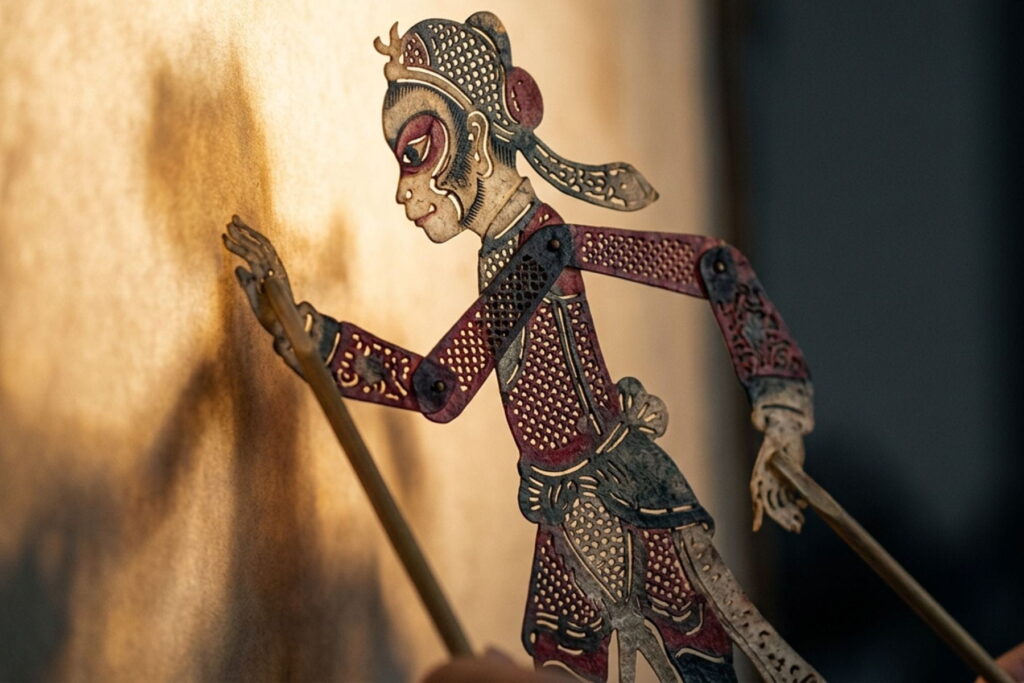
Designs are transferred to the prepared hide and cut with extraordinary precision using specialist knives and punches. The finest Chinese and Javanese puppets feature intricate pierced lacework — tiny perforations creating decorative patterns in headdresses, robes, and ornamental borders that cast delicate patterned shadows on the screen. A single elaborate puppet may require weeks of carving.
03
Colouring
In most traditions, completed puppets are painted with natural dyes or mineral pigments in rich, symbolic colours — even though the audience sees only a silhouette. This seemingly paradoxical practice reflects a conviction that the puppet’s beauty has value independent of its visibility: it is a complete object, possessed of integrity, whether seen directly or only as a shadow. In some Southeast Asian traditions, colour does filter faintly through thinner areas of hide, adding nuance to the projected image.
04
Articulation
Puppets are assembled from multiple separately cut sections — head, torso, upper and lower arms, legs — jointed at the shoulders, elbows, hips, and knees with thread or rivets. Each movable section is controlled by a slender rod of bamboo or wire, held and manipulated by the puppeteer. The most elaborate Javanese Wayang Kulit figures may have a dozen or more independently articulated parts, enabling the full physical vocabulary required by epic narrative.
05
The Screen & Light
Performance requires a screen of white cloth or translucent cotton, stretched taut on a wooden frame. Historically, a single oil lamp — its flame carefully tended throughout the performance — provided the light source. Today, electric lamps are common, but practitioners of the highest traditions maintain that the organic flicker of an oil or coconut-oil flame contributes an irreplaceable quality of animation and warmth to the projected images that no electric substitute replicates.
The Seen and the Unseen: A Theatre Built on Paradox
The Seen and the Unseen: A Theatre Built on Paradox
Shadow puppetry is an art structured around a series of profound paradoxes, each of which contributes to its peculiar expressive power. The puppet is elaborately made yet invisible to its audience. The puppeteer is the animating intelligence of the entire performance yet hidden from view. The most vivid presences on the screen — gods, heroes, demons, dragons — exist only as absences in a beam of light. These are not incidental features of the form; they are its philosophical substance.
The Hidden
What Remains Unseen
The puppet in its full material reality — intricately carved, richly coloured, warm to the touch — is invisible to the audience. The puppeteer, who gives voice to every character, who embodies every emotion, who is the true author of the performance, works in darkness, unseen. The physical reality of the performance is entirely concealed.
The Revealed
What the Screen Discloses
The shadow — a two-dimensional projection, a reduction to pure silhouette — carries the entire weight of drama, character, and emotion. Paradoxically, this simplification intensifies rather than diminishes: stripped of material texture and colour, the figure becomes pure gesture, pure presence, and the imagination of the audience completes it with a richness that no literal representation could supply.
In many traditions, this structural paradox carries explicit metaphysical significance. The dalang — the Javanese master puppeteer — is understood to occupy a position precisely analogous to that of the divine creator: hidden from the world he animates, the source of all voices and all actions, yet himself absent from the story he tells. The lamp is the sun; the screen is the world; the puppets are the souls of created beings, made luminous and vital only by the light that passes through them. To watch a Wayang Kulit performance is to watch a cosmological allegory unfold in real time.
A Global Tradition
Regional Traditions: One Form, Many Worlds
Shadow puppetry is, uniquely among major performing arts, a form that emerged across multiple cultures independently and that spread along the trade and cultural exchange routes of the ancient and medieval world into an extraordinary range of regional traditions. Each is distinct in its materials, its aesthetic vocabulary, its narrative repertoire, and its cultural function — yet all share the irreducible theatrical fact of light, screen, and the shadow of a hand.
Chinese Shadow Theatre 皮影戲 · Píyǐngxì
China · Han Dynasty onward
The oldest and most historically documented shadow puppet tradition, Píyǐngxì reached its highest refinement in the northern provinces of Shaanxi, Hebei, and Gansu. Chinese shadow puppets are celebrated for the extraordinary intricacy of their carved leather lacework — headdresses and robes of near-miraculous delicacy — and for the fusion of puppetry with singing, music, and spoken drama that characterised classical performance. The repertoire drew from Chinese historical epic, popular literature, and Confucian moral narrative, including beloved cycles such as Romance of the Three Kingdoms and Journey to the West. Travelling troupes performed in temple courtyards and village squares across the agricultural calendar, marking festivals, harvests, and religious occasions.
Wayang Kulit Wayang Kulit · Shadow Leather
Indonesia · Java & Bali
Indonesia’s Wayang Kulit is arguably the most philosophically and spiritually elaborate shadow puppet tradition in the world — a performance form so deeply woven into the fabric of Javanese civilisation that it was recognised by UNESCO in 2003 as a Masterpiece of Oral and Intangible Heritage of Humanity. Performances draw from the Hindu epics Mahabharata and Ramayana, and from the rich body of indigenous Javanese legend. The master puppeteer — the dalang — commands a position of extraordinary cultural authority: he must have mastered not only the physical manipulation of hundreds of distinct puppet figures, but the philosophical texts, musical scores, poetic speech registers, and spiritual disciplines of a tradition of breathtaking complexity. A single Wayang Kulit performance may last through the entire night — beginning at dusk, ending at dawn — and is considered simultaneously entertainment, spiritual ceremony, and moral instruction.
Indian Shadow Traditions Tholu Bommalata · Tolu Bommalatam
India · Multiple Regional Forms
India sustains a remarkable diversity of shadow puppet traditions, each rooted in a distinct regional language, mythology, and visual aesthetic. Tholu Bommalata of Andhra Pradesh — “the dance of leather puppets” — features some of the largest and most vividly painted puppets in the world, some exceeding a metre in height. Togalu Gombeyaata of Karnataka, Ravanachhaya of Odisha, and Chaya Nataka represent further regional traditions of great antiquity and beauty. In virtually all Indian forms, the narrative foundation is the Hindu epics — the Ramayana and Mahabharata — and performances are understood as acts of religious devotion as much as theatrical entertainment. The puppeteer is frequently a hereditary artist, belonging to a caste whose identity is defined by the practice of this art.
Thai Shadow Theatre Nang Yai · Nang Talung
Thailand · Central & Southern Forms
Thai shadow puppetry divides into two distinct traditions of strikingly different character. Nang Yai — literally “big hide” — is a grand, ceremonial form practiced at royal and temple occasions, using enormous non-articulated puppets sometimes exceeding a metre in height. Performers carry these figures while executing highly stylised dance movements, creating a hybrid of shadow theatre and live performance of great visual majesty. Nang Talung, by contrast, is a popular southern form using smaller, articulated figures for informal community storytelling, combining sacred narrative with improvised comedy and social commentary in the manner of a beloved folk entertainer.
Karagöz and Hacivat Karagöz ve Hacivat
Turkey · Ottoman Tradition
Turkish shadow theatre centres on one of the world’s great comedy double acts: Karagöz, the blunt, earthy, illiterate commoner, and Hacivat, his pompous, educated, pretentious foil. Their dialogue — mixing slapstick, wordplay, social satire, and occasionally pointed political commentary — made Karagöz theatre the most popular form of entertainment in the Ottoman Empire for centuries. Performed particularly during the evenings of Ramadan, the shows were improvised around familiar scenarios, with the hayalci (shadow player) adapting his material to his audience’s moods and current events. UNESCO inscribed Karagöz on its Intangible Cultural Heritage list in 2009. The puppets, carved from camel hide and coloured in jewel-bright tones, are among the most characterful objects in any shadow puppet tradition.
Narrative & Meaning
Stories Told in Shadow: Themes, Repertoire & Cultural Function
The narrative repertoire of shadow puppetry is as vast as the cultures that have practiced it, yet certain themes recur with such consistency across traditions as to constitute something close to a universal language of shadow theatre. The great epics — of heroes and demons, of righteous kings and monstrous adversaries, of divine intervention and human weakness — form the spine of the repertoire in virtually every tradition. Around this epic core, each culture has layered its own specific mythological, historical, comic, and satirical material.
- Sacred Epic — the Ramayana, Mahabharata, Journey to the West, and other foundational religious narratives
- Cosmological Drama — the creation of the world, the battles of gods and demons, the establishment of cosmic order
- Historical Chronicle — the deeds of rulers, the rise and fall of dynasties, tales of loyalty and betrayal
- Moral Instruction — the consequences of virtue and vice, the rewards of filial piety and devotion
- Folk Comedy — tricksters, fools, social types, the comic deflation of pretension and authority
- Political Satire — in the Turkish Karagöz tradition and in contemporary adaptations across Asia
- Spirit World — encounters with gods, ancestors, demons, and the supernatural powers that govern human fate
- Contemporary Themes — in modern adaptations: environmental concern, migration, social justice, and the challenges of rapid change
What distinguishes shadow puppetry’s treatment of these themes from most other theatrical forms is the particular quality of presence that the shadow screen creates. In darkness, before a lit cloth, the usual categories of the real and the fantastic become permeable. Gods and demons inhabit the same visual space as human figures; the spirit world intrudes upon the everyday world with a naturalness that mirrors the cosmological convictions of the traditions in which these stories originated. Shadow puppetry does not merely depict the interpenetration of the visible and invisible worlds — it enacts it.
The Master Performer
The Puppeteer as Priest: Sacred Knowledge & Cultural Authority
In many shadow puppetry traditions, the practitioner occupies a social and spiritual position that goes far beyond that of entertainer. The Javanese dalang, the Indian hereditary puppet family, the Chinese travelling troupe master — each embodies a form of accumulated cultural knowledge so extensive and so carefully transmitted that their practice constitutes a kind of priestly or shamanic function within their communities.
The dalang must command the philosophical content of the stories he tells — the theological and ethical frameworks of Hindu-Javanese cosmology, the intricate genealogies of hundreds of characters, the specific dramatic conventions governing every scene type. He must be a musician, controlling the gamelan orchestra with coded signals while manipulating dozens of puppet figures. He must be a linguist, moving between multiple register levels of Javanese — from the archaic Sanskrit-inflected speech of gods to the vernacular of comic characters. He must be a spiritual practitioner, able to enter altered states of consciousness and to manage the ritual dimensions of an all-night performance that is understood as a genuine act of spiritual mediation.
This dimension of shadow puppetry — the practitioner as the living repository of a tradition whose depth exceeds any individual life — gives the art its particular urgency in the face of modernisation. What is at risk when a shadow puppet tradition declines is not merely an entertainment form or a craft technique, but an entire system of knowledge, spiritual practice, and communal memory that took centuries to accumulate and that exists nowhere outside the living body and trained mind of its practitioners.
Asian Art Federation
501(c)(3) non-profit organization
Federation of Asian Art and Culture Inc.
Dedicated to the study, preservation, and cultural interpretation of Asian artistic traditions.
© 2026 Asian Art Federation. [Read Full Disclaimer]