Asian Art Federation
Lion Dance
Lion dance (舞獅, wǔshī) is one of the most widely recognized forms of Chinese ritual performance — a tradition rooted in cosmological belief, martial culture, and community identity, performed continuously for more than two thousand years and carried across the world by Chinese diaspora communities.
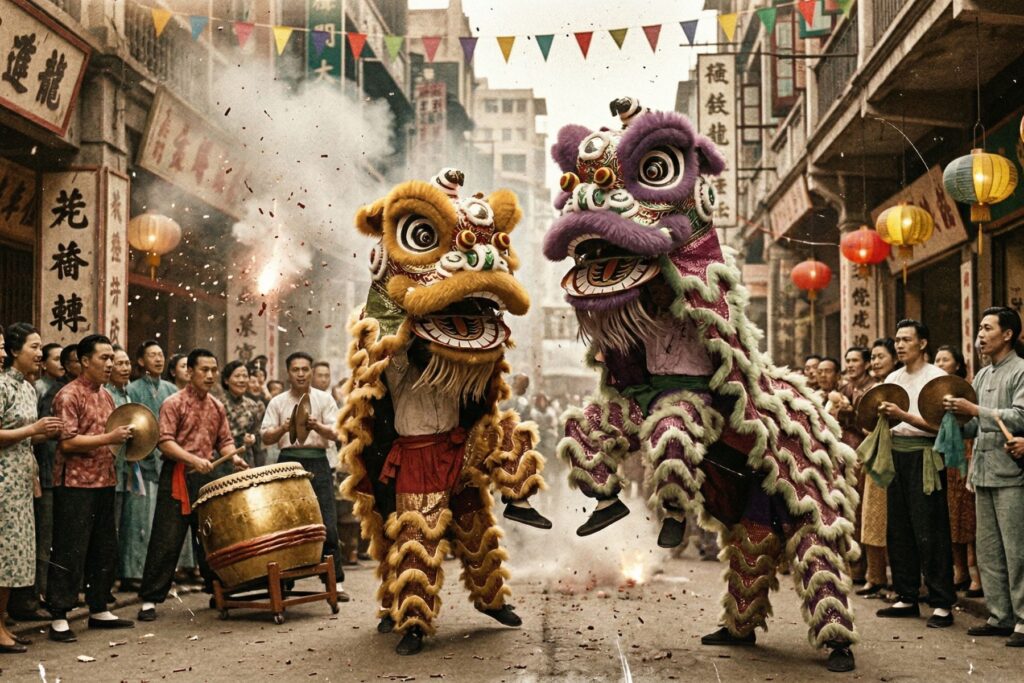
Performed by two dancers within an articulated costume of bamboo, lacquered papier-mâché, silk, and fur, the lion dance is at once a work of applied craft, a choreographed ritual, and a vehicle of cultural memory. Its study intersects art history, material culture, performance studies, and the history of religion — making it a rich subject for scholarly engagement.
For the Asian Art Federation, the lion dance represents a tradition of particular interest: a performance form shaped by centuries of cross-cultural transmission along the Silk Road, embedded in Chinese cosmological thought, and expressed through objects of considerable artistic and material complexity. This page presents the historical and cultural context of lion dance as a subject of serious inquiry.
Subject Area
Ritual Performance and Folk Art
Script
Han Dynasty – Present
Period
Material Culture, Diaspora Studies, Ritual Studies
origins and silk road
A Foreign Animal, a Chinese Tradition
One of the most revealing facts about the lion dance is that lions were never native to China. The lion — an animal understood in traditional Chinese culture as mythical, like the dragon or phoenix — arrived in the Chinese imagination through contact with Central Asia, Persia, and South Asia along the Silk Road trade networks that expanded dramatically during the Han dynasty.
Emissaries from Central Asia and the Parthian Empire presented lions to the Han court as diplomatic gifts. According to ethnomusicologist Laurence Picken, the Chinese word for lion itself, shi (獅), may have been derived from the Persian word šer. The lion thus entered Chinese visual and ritual culture not as a native creature but as an exotic import — a symbol of distant power and unfamiliar majesty, quickly absorbed into Chinese cosmological frameworks and transformed into something distinctly its own.
“Since lions have never been a part of China’s natural environment, how did they come to be such iconic inhabitants of the Chinese cultural landscape?”
Association for Asian Studies — Education About Asia
Early textual evidence suggests lion performances were already present in China by the Three Kingdoms period (220–280 CE), with the first written record appearing in Meng Kang’s commentary on the Book of Han: Record of Rites and Music. The tradition developed further with the spread of Buddhism through Central Asia into China during the Northern and Southern Dynasties (420–589), as the lion — an animal with deep symbolic significance in Buddhist iconography as a protector of the dharma — gained additional layers of religious meaning in Chinese practice.
The dance’s foreign origins were not concealed. Tang dynasty writers and poets recognized it explicitly as a foreign form. The poet Bai Juyi (白居易, 772–846 CE), in his poem “Western Liang Arts” (西凉伎), described a lion dance performed by two hu dancers — meaning non-Han performers from Central Asia — in a costume of wooden head, silk tail, and fur body, with eyes gilded with gold and silver-plated teeth. The form he described closely resembles the lion dance as it continues to be performed today.
Historical Developments
From the Han Court to Global Performance
Chinese calligraphy is conventionally organised around five principal script styles, each with its own historical development, formal characteristics, and aesthetic values. These are not merely different ways of writing the same characters — they represent distinct philosophical and aesthetic orientations toward the act of inscription itself.
Han Dynasty
206 BCE–220 CE
First Contact and Early Mimicry
Lions arrive in China as diplomatic tributes from Central Asian states. Court performers begin imitating the movements of these unfamiliar animals. The earliest proto-lion performances are associated with this period of expanded Silk Road exchange, alongside the introduction of other Central and West Asian performance forms.
Three Kingdoms and Northern/Southern Dynasties
220–589 CE
Buddhist Influence and Ritual Integration
Lion performances become increasingly integrated with Buddhist ritual culture as the religion spreads through China. The lion’s role as a protector in Buddhist iconography deepens its symbolic function in Chinese performance. This period sees the first written documentation of something recognizable as a lion dance.
Tang Dynasty 618–907 CE
Imperial Peak: the “Five Directions Lion Dance”
The lion dance reaches its peak of imperial elaboration. At the court of Emperor Xuanzong, the “Lion Dance of the Five Directions” (五方師子舞) — also called “Great Peace Music” (太平樂, Tàipíng yuè) — was performed with five large lions of different colours, each led by two handlers and accompanied by 140 singers. Each lion expressed a different mood and embodied a cardinal direction. By the eighth century, the form had transmitted to Japan as formal court entertainment.
Song and Ming Dynasties 960–1644 CE
Popular Diffusion and Regional Divergence
The lion dance transitions from an exclusively imperial entertainment into a popular festival tradition. The Northern Lion style becomes established as a distinct form. In southern China — likely during the Ming dynasty — the Southern Lion develops as a regional adaptation rooted in Guangdong province, particularly in the area of present-day Foshan. The lion dance’s head designs, in the south, begin drawing on the visual language of Chinese opera facial makeup, producing the distinctive expressive heads of the Cantonese tradition.
Qing Dynasty 1644–1912 CE
Political Resistance and Martial Lineages
Lion dance becomes closely associated with southern martial arts schools and, in some accounts, with anti-Qing resistance movements. Revolutionary martial artists reportedly used lion dance troupes as networks for political organization. The connection between lion dance and kung fu (particularly the southern styles of Cantonese martial culture) becomes deeply embedded in this period, shaping the tradition’s identity for generations.
20th Century–Present
Suppression, Revival, and Globalization
Lion dance is suppressed during the Cultural Revolution (1966–1976) on the Chinese mainland, prompting important centres of practice to shift to Hong Kong, Taiwan, Malaysia, and Singapore. The International Dragon and Lion Dance Federation (IDLDF) is established in Hong Kong in 1995. Today the tradition is practised across Southeast Asia, Europe, North America, and beyond — classified in China as an item of national intangible cultural heritage.
The Two Major Traditions
Northern Lion and Southern Lion
The history of lion dance has produced two major and visually distinct traditions — the Northern Lion and the Southern Lion — each reflecting the values, martial cultures, and aesthetic sensibilities of the regions in which they developed. Understanding the differences between them is essential for interpreting lion dance as a material and ritual form.
Northern Tradition — 北獅
The Northern Lion
Originating in the courts of the north and associated with Beijing and Hebei province, the Northern Lion is more naturalistically styled — its costume often likened to a Pekingese dog, with a shaggy mane of red and gold fur and a relatively realistic facial structure.
Northern performances emphasize acrobatics over martial expression: adult and juvenile lions perform together, balancing on giant balls, navigating seesaws, and engaging in playful wrestling. The tone is frequently familial and comic rather than martial.
- Four-legged costume with realistic mane
- Acrobatic and gymnastic movement style
- Performed as paired male and female, or adult and juvenile
- Associated with northern martial and court traditions
- Common in state-sponsored festival contexts
Southern Tradition — 南獅
The Southern Lion
Originating in Guangdong province — and associated internationally with the global Chinese diaspora — the Southern Lion is more stylized and more dramatically expressive. Its oversized head draws on the aesthetic of Chinese opera facial makeup, with movable eyelids and mouth, a prominent central horn, and a mirror mounted on the forehead.
Southern performances are deeply rooted in kung fu traditions, with footwork drawn directly from martial arts stances. The emotional range of the lion — curiosity, alertness, aggression, joy — is conveyed through the head’s movements in dialogue with the percussion.
- Two-legged costume with large, expressive head
- Movements drawn from Cantonese kung fu
- Opera-influenced facial design with movable features
- Mirror on forehead to repel evil spirits
- Predominant style globally due to diaspora diffusion
Sub-styles within the Southern Tradition
Fut San and Hok San
Within the Southern Lion tradition, two primary sub-styles are distinguished: the Fut San (佛山, Foshan) style and the Hok San (鶴山, Heshan) style, each named for its place of origin in Guangdong province. The Fut San style is characterized by an aggressive, tall lion head; the Hok San style features a flatter, more animal-like form. A hybrid style — Fut-Hok — developed in Singapore. Each sub-style has its own characteristic musical rhythms, movement vocabulary, and philosophical approach to the performance.
Ritual Structure and Performance
Music, Movement, and Meaning
Lion dance performances are structured ritual events in which music, movement, and symbolic action are integrated into a coherent whole. The percussion ensemble — comprising a large drum, cymbals, and a gong — is not mere accompaniment: it directs the lion’s movements, communicates emotional states, and serves the ritual function of driving away malevolent forces through sound.
The drum establishes the primary rhythmic structure to which the dancers synchronize their movements. The relationship between drummer and performers is dialogic — when the lion is curious and investigative, the music quietens; when the lion is aggressive and charges, the percussion intensifies suddenly. This responsiveness gives skilled performances their quality of authentic animal behaviour.
The Cai Qing Ritual
The climax of many Southern lion dance performances is a ritual known as Cai Qing (采青), or “Plucking the Greens.” A head of lettuce — sometimes along with other greens — is hung above the entrance of a business or home, often at considerable height, with a red envelope (hongbao) containing money concealed within the leaves. The lion must locate, “eat,” and “spit back” the greens in an auspicious manner — returning the lettuce in the shape of good fortune characters to the audience — before receiving the red envelope. In competitive contexts, greens have been hung as high as five to six metres, requiring well-trained martial artists to execute the manoeuvre while wearing the heavy costume.
Opening Bow 開場鞠躬
All performances begin with a formal bowing ceremony — a greeting that acknowledges the spiritual significance of the occasion and pays respect to the venue, the audience, and any deities associated with the space. The opening bow is performed at both the beginning and conclusion of every lion dance.
Awakening Sequence 醒獅
The lion is born into each performance through a sequence of awakening movements — blinking, stretching, scratching, and surveying the environment. This sequence, drawn from close observation of feline behaviour, is central to the Southern tradition and gives the performance its expressive, character-based quality.
Cai Qing 采青
The central ritual act: the lion locates and consumes suspended lettuce or other greens, redistributing them to the audience as a blessing of prosperity. In business-opening ceremonies, this constitutes the core apotropaic function of the performance — clearing obstacles and inviting financial success.
Stacking and Acrobatics 疊羅漢
In competition and demonstration contexts, the tail dancer lifts the head dancer to achieve elevated positions — the head standing on the tail dancer’s shoulders or head. These acrobatic “stacks” require extensive physical training and precise coordination, and are judged in formal competitive contexts on difficulty, execution, and artistic expression.
Diaspora and Cultural Transmission
Lion Dance Beyond China
One of the most significant aspects of the lion dance as a cultural phenomenon is its transmission across the world through Chinese diaspora communities — a process that began centuries ago and continues to shape the tradition’s development today. The lion dance is now performed in Southeast Asia, Japan, Korea, Taiwan, North America, Europe, and as far as Latin America and East Africa.
Southeast Asia
The Southern Lion tradition predominated in the diaspora communities that emigrated primarily from Guangdong and Fujian provinces to Malaysia, Singapore, Indonesia, Vietnam, and the Philippines. In these communities, lion dance became a marker of Chinese identity and a mechanism of social cohesion — particularly in the overseas Chinese martial arts schools that served as community institutions.
Malaysia and Singapore became important centres of innovation during the Cultural Revolution period, when practice on the mainland was suppressed. Competitive lion dance — including the high-pole (gao zhuang) style, in which performers navigate elevated poles — was significantly developed in this period. The International Dragon and Lion Dance Federation, established in Hong Kong in 1995, now organizes competitions across East and Southeast Asia.
Taiwan
The history of lion dance in Taiwan is distinctive, shaped by waves of mainland Chinese immigration from the seventeenth century, Japanese colonial governance in the early twentieth century, and subsequent political separation from the People’s Republic. The Taiwanese lion dance tradition has diverged significantly from its mainland origins, developing unique local characteristics while preserving elements of the Guangdong tradition brought by early immigrants.
In Taiwan, the lion dance’s martial and protective functions were at various times assumed by police and military institutions. Today it remains a vital community practice, with organizations such as the Dalongdong lion dance lineage preserving historical forms and transmitting them through structured training.
As a performance tradition transmitted through diaspora communities, the lion dance raises important questions for scholars of Asian art and cultural history: how do performance traditions maintain coherence across vast geographic distances and multiple generations? How do they adapt to new social contexts while preserving core ritual meanings? And what can they tell us about the mechanisms of cultural memory and identity formation in migrant communities?
Asian Art Federation
501(c)(3) non-profit organization
Federation of Asian Art and Culture Inc.
Dedicated to the study, preservation, and cultural interpretation of Asian artistic traditions.
© 2026 Asian Art Federation. [Read Full Disclaimer]