Preservation Highlights
Preservation through Documentation
Preservation is central to meaningful cultural work. AAF supports documentation projects that contribute to the long-term study of Asian artistic traditions — sustaining cultural knowledge for future scholars, institutions, and communities.
Initiatives in Development
Without documentation, context is lost. Without preservation, artistic traditions risk being reduced to isolated objects rather than understood as part of larger systems of thought, practice, and cultural transmission.
The Asian Art Federation understands preservation not simply as the conservation of physical objects, but as the responsible documentation of the knowledge, context, and histories that give those objects meaning. A painting without its provenance, a manuscript without its transmission history, a seal without its identification — these are objects diminished. Documentation restores what time and displacement erode.
AAF supports documentation initiatives that capture and organize this contextual knowledge — contributing to the long-term study of Asian artistic traditions and ensuring that future scholars have the material they need to work rigorously and responsibly.
Preservation is not only the care of objects. It is the responsible preservation of context, scholarship, and cultural memory.
Our Process
Six Areas of Preservation Work
AAF’s documentation work is organized around six areas of activity. Each addresses a distinct dimension of cultural knowledge — from the physical object to its historical context, ownership history, and scholarly record.
1
Archival Documentation
The systematic organization and preservation of records related to works of art — including exhibition histories, correspondence, institutional files, and scholarly notes. Archival documentation creates the paper trail through which an object’s history can be traced and verified.
2
Cataloguing
The structured description and classification of works, collections, and related materials according to consistent scholarly standards. Careful cataloguing makes cultural objects findable, comparable, and accessible — to researchers, institutions, and future generations.
3
Provenance Research
The investigation of ownership and collection histories — tracing how objects have moved between individuals, institutions, and countries over time. Provenance research is essential both for responsible scholarship and for the ethical study of cultural heritage.
4
High-Resolution Imaging
The production of detailed photographic documentation that captures surface texture, inscription detail, condition, and formal qualities invisible to ordinary viewing. High-resolution imaging creates lasting visual records that support remote study, publication, and comparison.
5
Seal and Inscription Study
The identification, transcription, and analysis of the seals, colophons, dedications, and inscriptions that appear on works of Asian art — often providing the most direct evidence of an object’s authorship, date, ownership history, and cultural significance.
6
Comparative Study Archives
The development of reference collections — visual, textual, and material — that enable systematic comparison across objects, periods, and traditions. Comparative archives are foundational tools for connoisseurship, attribution research, and the study of artistic transmission.
Why Preservation Matters
Culture Without Context Is Diminished
At a time of rapid cultural change — when collections are dispersed, institutions restructured, and generational knowledge lost — the documentation of artistic traditions has never been more urgent. Objects survive; the knowledge that surrounds them is far more fragile.
The inscription fades. The collector’s notes are discarded. The kiln site is built over. The scholar who spent decades studying a particular tradition retires without having recorded what she knew. Each of these is a small cultural loss; cumulatively, they are vast.
AAF’s preservation work is a response to this fragility. It is not archival for its own sake, but in service of scholarship — ensuring that the knowledge required to study Asian artistic traditions responsibly remains accessible, legible, and alive.
Strategies for Safeguarding the Legacy of Ancient Art
Preserving the richness of ancient artistic traditions requires a careful balance of documentation, conservation, and scholarly study. Through these approaches, we ensure that cultural heritage is not only protected but also made accessible for future generations to explore and understand.
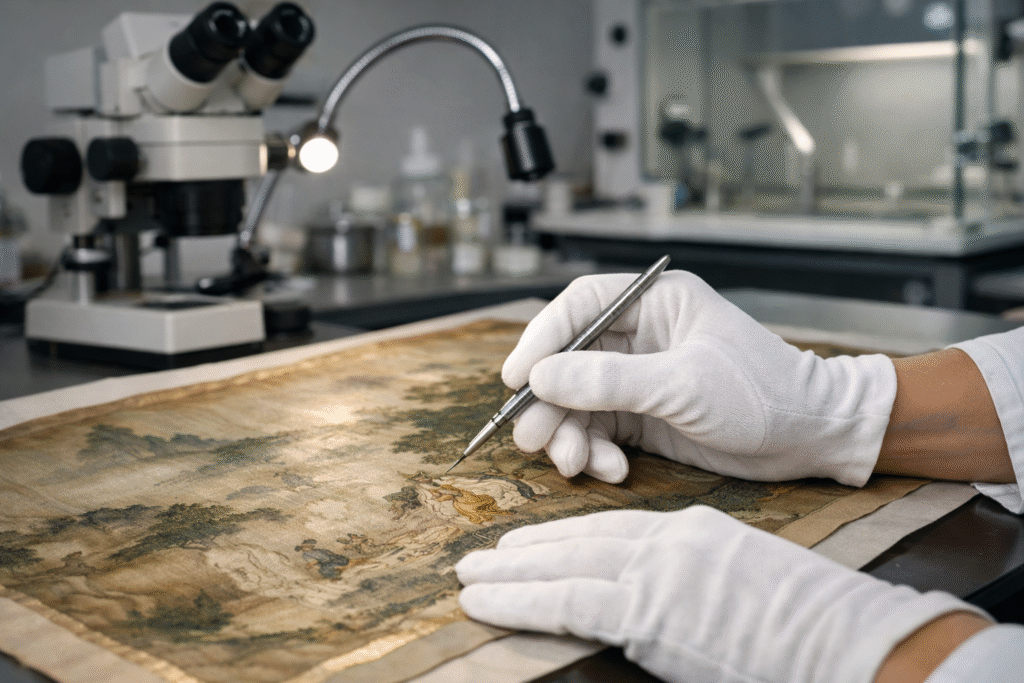
Painting Conservation Lab
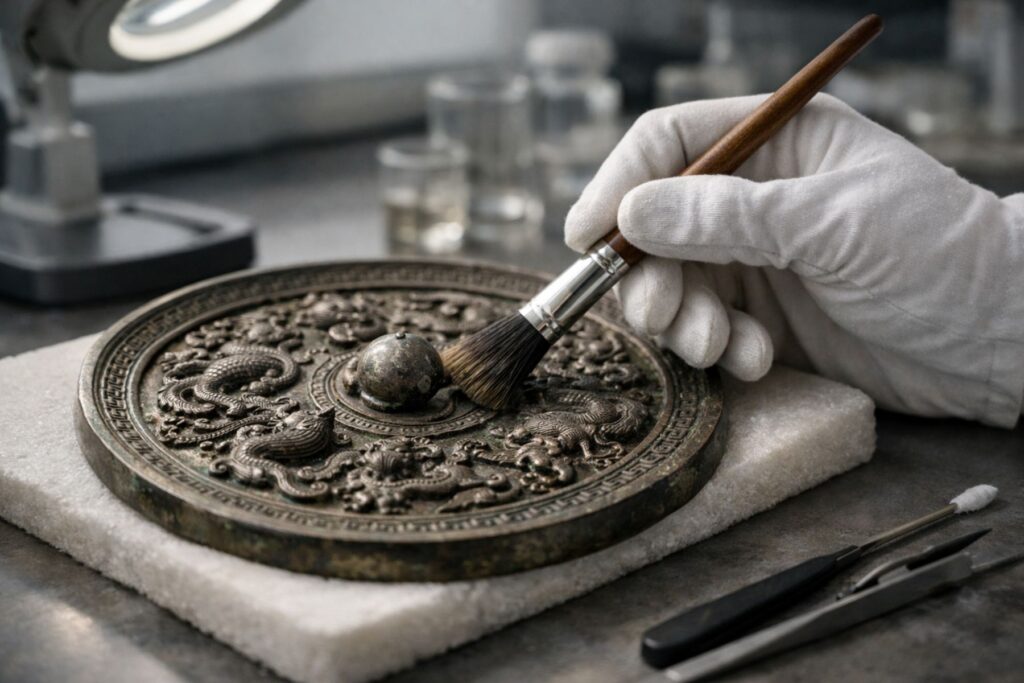
Bronze Mirror Conservation
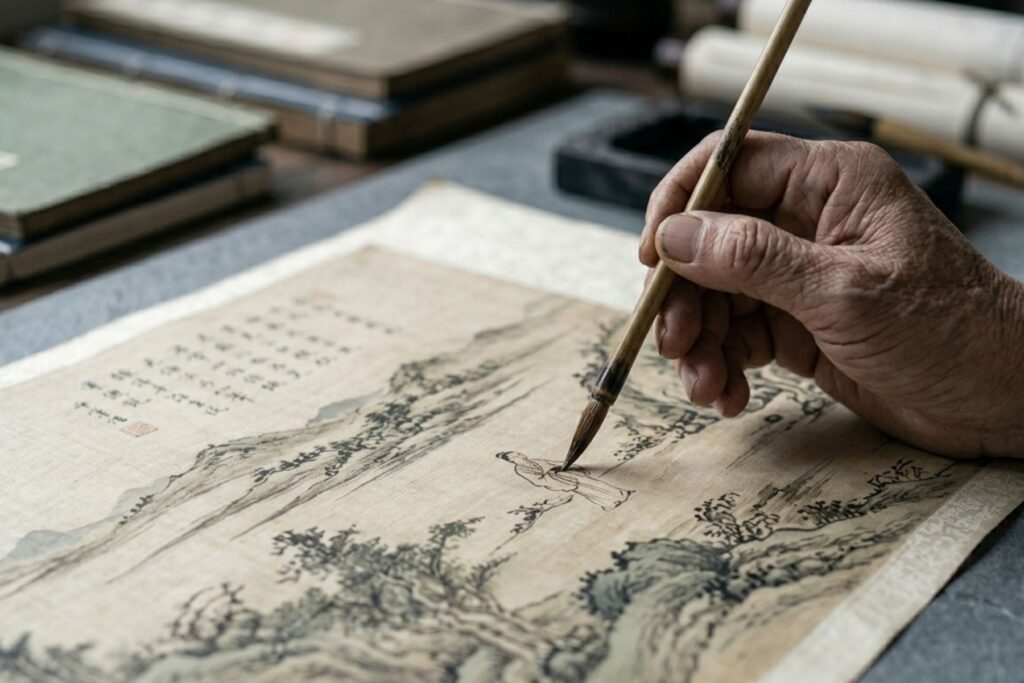
Silk Manuscript Retracing
Enduring Treasures: The Preservation of Art Across Time
The careful preservation of artworks ensures that the vision, skill, and cultural significance of past generations endure. By safeguarding these artistic treasures, we maintain a bridge between history and the present, allowing future audiences to engage with and learn from the richness of our shared heritage.
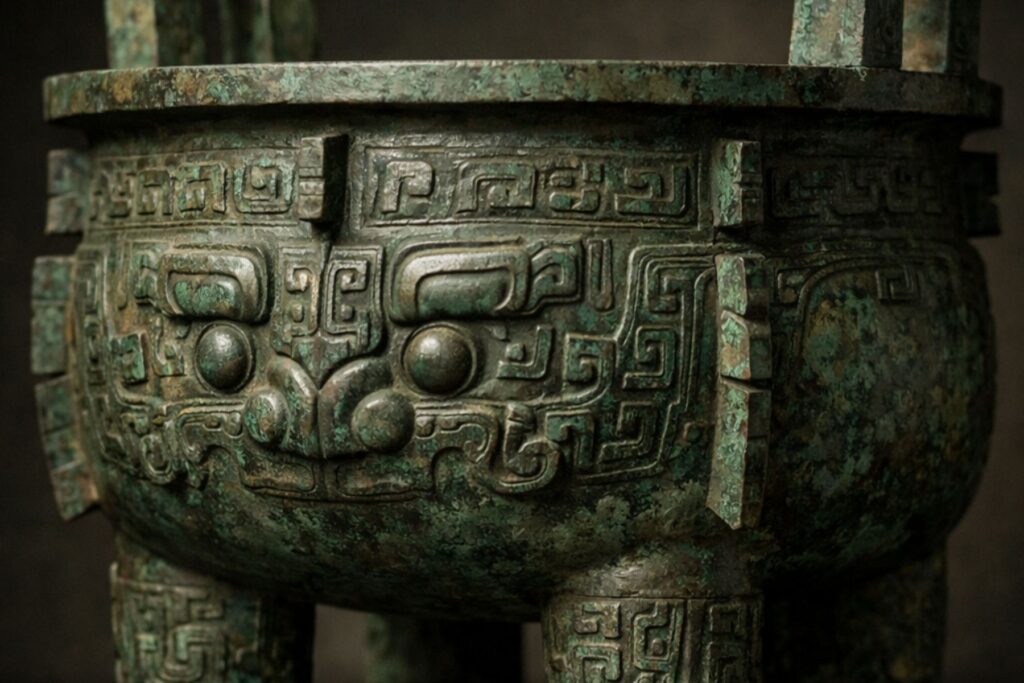
A well-preserved Bronze Ding
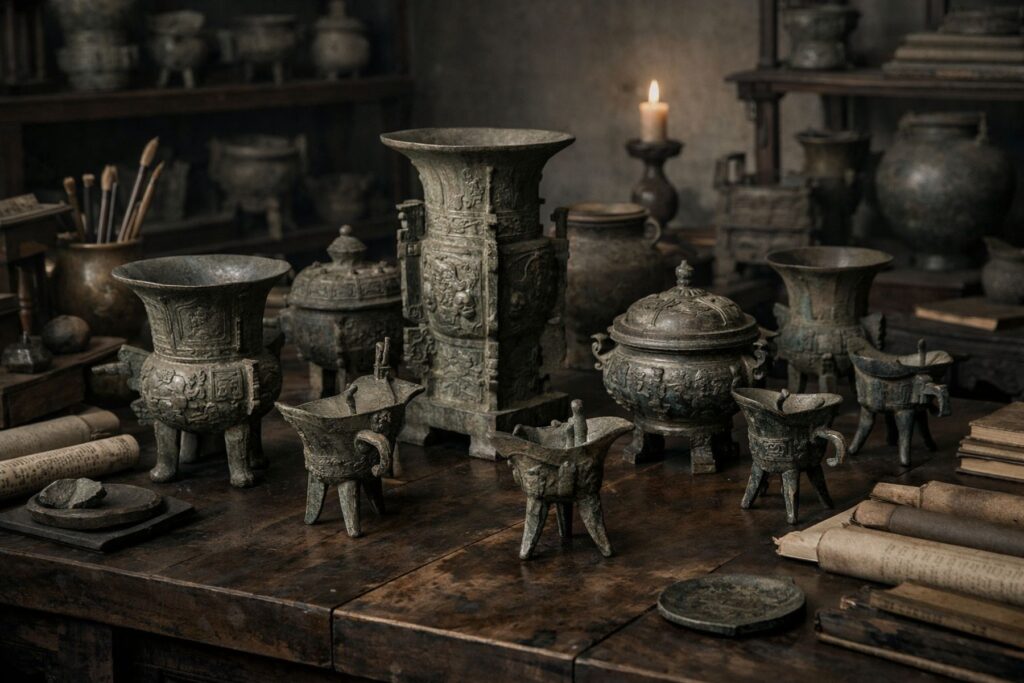
A Collection of Bronze Ritual Vessels
A Future Initiative
Stay Connected For Updates
AAF’s preservation and documentation programs are currently being developed. We are in the process of identifying priority areas, establishing partnerships, and designing the frameworks within which this work will be carried out.
Updates on specific projects and partnership opportunities will be announced as programs are finalized. Scholars, institutions, and professionals with relevant expertise are welcome to make contact in advance of these announcements.
Fill up the form to connect with us and be notified when specific documentation projects and partnership opportunities are announced. We communicate only when there is something substantive to share.
For institutional enquiries or to discuss potential collaboration, please contact us directly.