Feng Shui
Feng shui (風水) is one of China’s oldest and most enduring systems of thought — a tradition concerned with the relationship between human habitation, natural environment, and the movement of vital energy through the landscape.
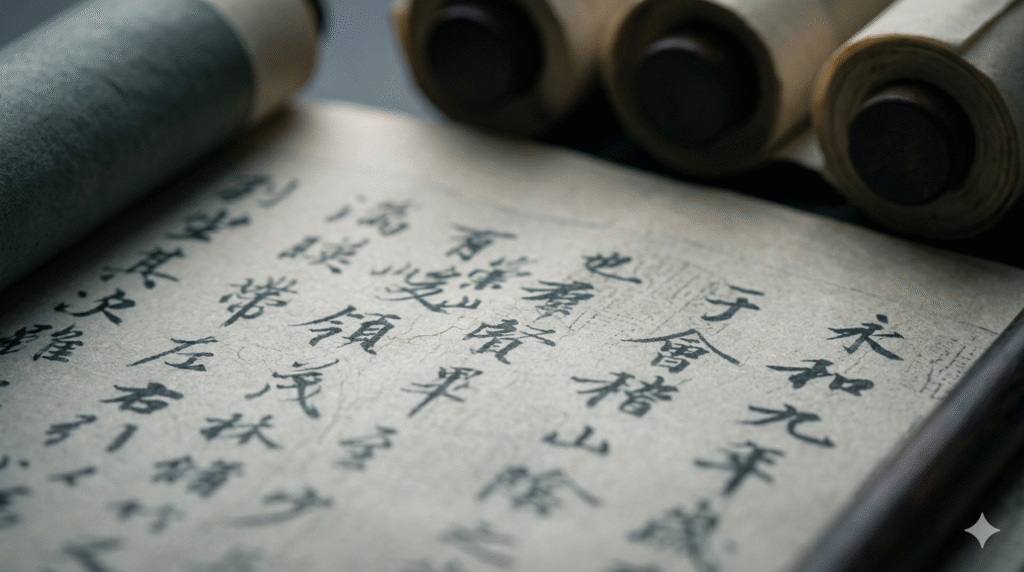
Literally translated as “wind” (風, fēng) and “water” (水, shuǐ), the term describes a practice that has shaped Chinese architecture, urban planning, burial rites, and domestic life for more than three thousand years. Its intellectual roots extend into Daoist cosmology, the theory of the five elements, the complementary principles of yin and yang, and early Chinese astronomical observation.
For scholars of Asian art and material culture, feng shui offers an indispensable framework for understanding the spatial, symbolic, and cosmological dimensions of Chinese architecture and design — from the layout of the Forbidden City to the siting of Ming dynasty tombs.
Contents
Subject Area
Chinese Cultural Philosophy
Period
Zhou Dynasty – Present
Related Fields
Architecture, Cosmology, Material Culture
Overview
Wind and Water: The Meaning of the Term
The term feng shui entered common usage during the Song dynasty (960–1279), though the practices it names are considerably older. Some of its techniques can be traced to Neolithic China, with successive elaborations added during the Han, Tang, Song, and Ming periods. The archaeological evidence and the rich oral histories of practicing lineages together attest to a tradition of remarkable continuity and adaptability.
The phrase appears formally in The Book of Burial (葬書, Zàngshu), attributed to the Jin dynasty scholar-poet Guo Pu (郭璞, 276–324 CE), who wrote that qi — the vital force that animates landscape and habitation alike — is dispersed by wind and halted by water. This formulation became foundational to later practice.
“Qi rides the wind and scatters; it is bounded by water and halts. The ancients gathered it to prevent its dissipation and guided it to ensure that it would halt: thus it was called feng shui.”
Guo Pu (郭璞), The Book of Burial, 4th century CE
In earlier literature, the practice was known by other names: kanyu (堪輿, “Heaven and Earth”), dili (地理, “Earth Principles” or Geography), and xiangzhai (相宅, “House Physiognomy”). This terminological plurality reflects the tradition’s deep entanglement with broader Chinese cosmological and divinatory systems, which resists easy separation into distinct disciplines.
Core Principles
Qi, Yin-Yang, and the Five Elements
Feng shui rests on a set of interconnected cosmological principles that are also fundamental to Chinese medicine, astronomy, and philosophy. Understanding these principles is essential for interpreting their architectural and artistic expressions.
Qi (氣) — Vital Energy
The concept of qi — variously translated as “breath,” “vital force,” or “life energy” — is central to all feng shui practice. Qi flows through the natural landscape, accumulates at certain points, and can be channelled, disrupted, or enhanced through the built environment. The goal of feng shui is to align habitation with the productive circulation of qi, and to avoid conditions in which it stagnates or disperses harmfully.
Yin (陰) and Yang (陽)
The paired principles of yin and yang — understood as opposing yet complementary forces operating throughout the cosmos — shape feng shui’s approach to site analysis and spatial arrangement. Yin denotes qualities of darkness, stillness, receptivity, and association with the dead; yang denotes light, movement, activity, and the living. This polarity organizes the distinction between yin houses (burial structures, tombs) and yang houses (dwellings and palaces for the living), each subject to its own feng shui considerations.
The Five Elements (五行, Wǔ Xíng)
Feng shui’s analysis of space and material is further structured by the system of five phases or elements — each understood not as a literal substance but as a category of force, movement, and relationship.
木 Wood
火 Fire
土 Earth
金 Metal
水 Water
The five elements interact through cycles of generation and control — wood feeds fire, fire creates earth, earth produces metal, metal holds water, water nourishes wood. Feng shui practitioners use these relationships to assess the elemental balance of a site or structure and to recommend additions or modifications.
Historical Development
From Neolithic Origins to Imperial Institution
The history of feng shui spans more than three millennia, developing through successive phases of elaboration, institutionalization, and popular diffusion.
Zhou Dynasty 1046–256 BCE
Cosmological Foundations
The Zhou period saw the emergence of the I Ching (易經) and the system of trigrams that would become integral to later feng shui practice. Chinese astronomers used circumpolar stars to determine precise north-south orientations for settlements and ritual structures. The Shang palaces at Xiaotun, aligned 10° east of due north, reflect this early astronomical basis.
Han Dynasty 206 BCE–220 CE
Systematization and Imperial Adoption
Feng shui became formally integrated into Chinese imperial governance during the Han dynasty, with court officials conducting geomantic assessments for the siting of palaces, capital cities, and imperial tombs. The Form school, the oldest branch of feng shui, takes shape in this period — originally concerned with the siting of tombs (yin house feng shui) before expanding to living structures.
Tang Dynasty 618–907 CE
Refinement and the Form School
Yang Yun-Sang (楊筠松), principal advisor to Emperor Xi Zong’s court, is credited with establishing the Form school as a systematic discipline. His teachings emphasized the reading of natural landforms — mountains, rivers, and terrain — as expressions of underlying qi. The Tang period also saw feng shui begin its diffusion beyond the imperial court into broader Chinese society.
Song Dynasty 960–1279 CE
Popular Diffusion and the Term “Feng Shui”
The term feng shui itself became common during the Song dynasty, as practices formerly reserved for the imperial elite and their advisors gradually permeated all levels of Chinese society. The Compass school developed alongside continued elaboration of Form school techniques, bringing greater mathematical and astronomical precision to geomantic analysis.
Ming and Qing Dynasties 1368–1912 CE
Institutional Peak
Feng shui reached its institutional zenith under the Ming and Qing dynasties. The Qintianjian (欽天監), the Imperial Astronomical Bureau, employed feng shui specialists alongside astronomers and calendar-makers. Major state projects — including the Forbidden City, the Ming Tombs, and planned capital cities — were designed in close accordance with geomantic principles. The dynasty’s claim to the Mandate of Heaven was partly expressed through the correct siting of imperial structures.
Classical Schools
The Form School and the Compass School
The Form School (形勢派)
The Form school is the oldest branch of feng shui, originating in the Han dynasty and systematized during the Tang. Its primary method is the close reading of natural landforms — the shape of mountains, the course of rivers, the contours of terrain — as expressions of qi.
An ideal site in this tradition is characterized by mountains to the rear offering protection, water in front accumulating qi, and gentle slopes on either side. This configuration, sometimes called the “armchair” formation, is legible in the siting of many imperial and elite burial complexes throughout China’s history.
The Compass School (理氣派)
The Compass school, associated with the Fujian region and formalized during the Song and Ming dynasties, employs the luopan (羅盤) — a geomantic compass of great complexity — along with astronomical calculations and numerological systems to determine auspicious orientations and temporal alignments.
Where the Form school reads the landscape empirically, the Compass school works with invisible forces, calculating the interaction of directional energies, elemental affinities, and time cycles. Its methods are more abstract and require considerable technical training to apply.
Notes
Two Approaches, One Tradition
Though often presented as competing systems, the Form and Compass schools are more accurately understood as complementary analytical frameworks within a shared cosmological worldview. In practice, skilled geomancers throughout history drew on both approaches, integrating landscape reading with directional and temporal calculation. The boundaries between schools were porous, and the oral transmission of specific techniques further complicates any strict classification.