A Study in Classical Chinese Theatre
Chinese Opera: The Total Art
Song, movement, painted face, and combat — an art form that synthesises every expressive discipline into a single, spectacular whole, and has done so for over two centuries
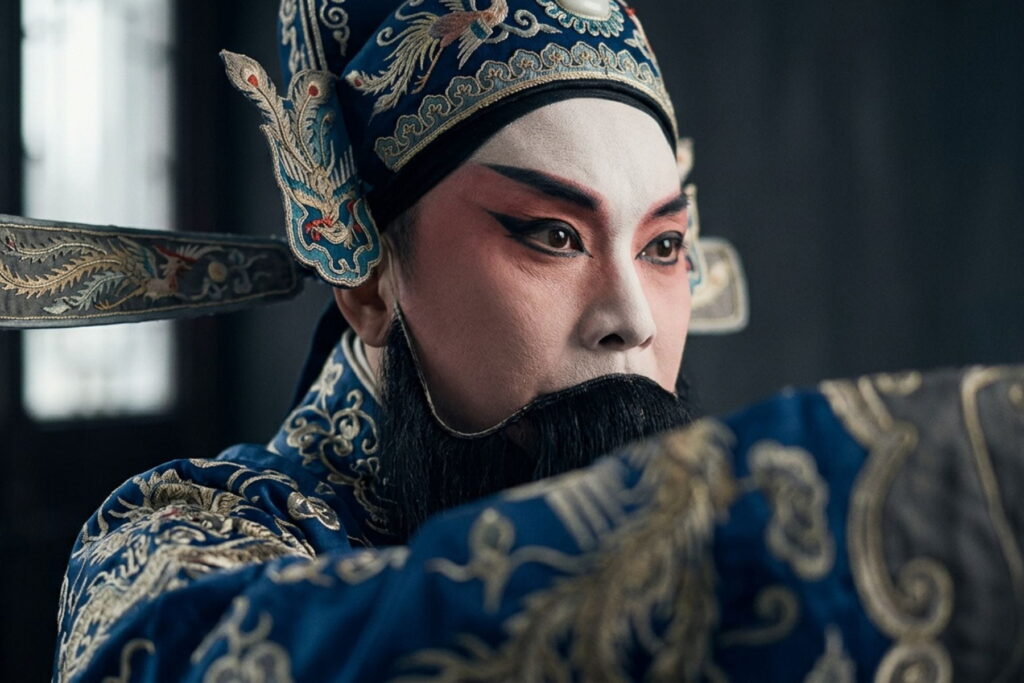
eft to right: a Dan (female role) in phoenix crown and water sleeves; a Jing (painted-face warrior) in full lianpu and battle armour; a Lao Sheng (older male official) in dragon robe and full beard — the three principal role types of Peking Opera’s classical stage.
Contents
The Art of Light & Shadow
Ancient Beginnings
The Art of Making Puppets
Performance & the Stage
Regional Traditions
Themes & Storytelling
Cultural Significance
The Puppeteer as Shaman
Preservation & Challenges
The Living Tradition
Subject Area
Performance Arts · Oral Tradition
Chinese Form
皮影戲 Píyǐngxì
Origin
Han Dynasty China, c. 206 BCE
UNESCO Status
Multiple traditions inscribed
Overview
The Art That Contains All Other Arts
Chinese opera — and within that vast tradition, Peking Opera (京劇, jīngjù) above all — occupies a position in Chinese cultural history that has no precise equivalent in the West. It is not merely a theatrical form, nor simply a musical genre, nor a tradition of costume or movement or storytelling. It is all of these simultaneously, fused in a single performance discipline of extraordinary complexity and beauty that the great scholar David Rolston described as “one of the most important ways that people in China for most of the last two centuries imagined the world.”
To encounter Chinese opera fully is to witness the synthesis — achieved through years, often decades, of the most demanding training — of song, spoken recitation, mime, dance, acrobatics, and martial combat into a form in which no single element may be separated from the others. The voice that sings is the same body that fights; the face that speaks is the same face painted with the symbolic vocabulary of an entire moral cosmology; the costume that catches the eye is simultaneously a precise sign system communicating character, rank, and emotional state to an audience versed in its conventions. Chinese opera is, in the fullest sense, a total art.
In Chinese opera, nothing is accidental and nothing is merely decorative. Every stroke of paint on a performer’s face, every movement of a sleeve, every shift in the pitch of a sung phrase — each is a precisely intentional sign within a language that took centuries to develop and that speaks to those who know it with extraordinary precision.
China is home to more than three hundred distinct regional opera forms, each with its own musical modes, vocal styles, costume traditions, and dramatic repertoire — a cultural richness that reflects the country’s extraordinary linguistic and regional diversity. Of these, Peking Opera, which crystallised in Beijing during the nineteenth century from the fusion of several regional traditions, has become the most widely known and most internationally recognised — the form that, for much of the world, stands as the emblem of Chinese theatrical art. It is the form to which UNESCO granted Intangible Cultural Heritage status in 2010, and it is the central subject of this study.
Historical Origins
From Regional Fusion to National Theatre
The roots of Chinese operatic performance extend deep into antiquity — to the ritual dances and masked performances of the Zhou dynasty, to the court entertainment traditions of the Tang, to the fully developed dramatic forms of the Song and Yuan dynasties. But Peking Opera as a distinct and coherent art form has a more specific and dateable origin: the autumn of 1790, when the Qianlong Emperor’s eightieth birthday celebrations brought four celebrated opera troupes from Anhui Province to Beijing to perform at the imperial court.
These Anhui troupes, performing the regional styles of huixi, found enormous popular resonance in the capital. They remained, absorbed the musical and dramatic conventions of Hubei’s hanxi tradition, and over the following decades fused these two streams — along with elements drawn from the older, aristocratic Kunqu form and from numerous other regional styles — into something new: a form simultaneously more accessible to a broad urban public and more musically sophisticated than any of its predecessors. By the middle of the nineteenth century, Peking Opera had become unambiguously China’s national theatre.
The patronage of the Empress Dowager Cixi from 1884 onward elevated Peking Opera to an almost sacred status within court culture, cementing conventions of performance, costume, and repertoire that persist to the present day. Training academies proliferated, producing successive generations of performers whose artistry was celebrated with the fervent attention that Western cultures accorded to great opera singers or prima ballerinas. By the turn of the twentieth century, Peking Opera was a cultural institution of the first order — the medium through which millions of Chinese people engaged with their history, their moral values, and their collective imagination.
On the Repertoire
Peking Opera’s repertoire encompasses more than 1,400 traditional works — drawn from Chinese dynastic history, mythology, folklore, and classical literature — as well as a growing body of contemporary compositions. No single performer masters more than a fraction of this vast archive in a career.
The Performer's Discipline
The Four Skills: A Total Discipline of the Body
The classical training tradition of Chinese opera identifies four fundamental skills — 四功五法, sìgōng wǔfǎ, the “four skills and five methods” — whose integration into a single, unified performance is the defining challenge and the defining achievement of the art. These are not separate disciplines that happen to occur in the same production; they are aspects of a single, indivisible practice, and the highest standard demands that they be present simultaneously at every moment of performance.
First Skill
Singing Chàng
The vocal heart of Chinese opera — a highly stylised, technically demanding form of singing that bears little resemblance to Western operatic convention. Peking Opera employs two primary melodic modes: xīpí, bright and animated, suitable for scenes of confidence and vitality; and èrhuáng, deeper and more lyrical, appropriate to solemnity, grief, and moral gravity. The voice is the primary vehicle of emotional communication, and its training — years of exercises to develop the particular resonances of the classical Chinese operatic voice, with its characteristic high placements and ornamental techniques — is among the most demanding aspects of the performer’s education.
Second Skill
Recitation
Spoken delivery in Chinese opera is not ordinary speech — it is a heightened, rhythmically structured form of recitation that occupies a middle ground between song and prose. Classical texts are delivered in archaic literary Chinese; colloquial passages in stylised vernacular. The art of niàn demands perfect diction, dynamic control, and a musicality of phrasing that makes even dialogue into a form of performance. Comedic and clown roles make particular demands on recitative skill, requiring rapid delivery, wordplay, and timing of the highest precision.
Third Skill
Acting & Movement
Chinese opera movement is governed by a vast and precisely codified vocabulary of gesture, posture, and mime — every action of hands, eyes, torso, and feet a deliberate sign within a system of theatrical convention that developed over centuries. Walking in a wide circle signals a long journey; smoothing one’s robes signals the approach of an important utterance; the manipulation of extraordinarily long water sleeves — extensions of the costume that amplify the arc of every hand movement — constitutes an expressive art in itself. The body is the instrument; its complete training, the lifelong task.
Fourth Skill
Combat & Acrobatics
Military plays and scenes of combat require performers to execute sequences of acrobatic martial technique — tumbles, spins, high kicks, weapon forms with the straight sword (jiàn), the broadsword (dāo), the spear, and the staff — coordinated with musical cues, with the movements of other performers, and with the overall theatrical arc of the scene. These sequences, choreographed to the driving percussion of the opera orchestra, require athletic conditioning of the highest order, and are trained from early childhood. The integration of these combat forms into the larger theatrical performance — so that they read not as gymnastic display but as drama — is one of Chinese opera’s most spectacular achievements.
Character & Role
The Four Role Types: A Complete Human Taxonomy
Chinese opera organises its characters not by individual psychology but by archetypal role categories — a system of types (行當, hángdang) that encodes age, gender, social status, moral character, and physical disposition into a set of recognisable conventions of voice, makeup, costume, and movement. This system, far from impoverishing characterisation, creates a theatrical language of extraordinary expressive efficiency: an audience versed in its conventions can read, at a glance, the essential nature of any character who enters the stage.
Male Roles
Sheng 生
The principal male roles of Chinese opera, encompassing a wide range of types. Lǎo shēng (old men) — dignified officials, scholars, and military commanders, typically bearded, performing in the middle and lower vocal registers, conveying gravitas and moral weight. Xiǎo shēng (young men) — romantic heroes and young warriors, sung in a distinctive combination of full and falsetto voice, wearing no beard, often carrying fans. Wǔ shēng (martial male) — the physically demanding acrobatic roles, requiring exceptional athletic skill. Each subdivision carries its own gestural conventions, vocal demands, and dramatic associations accumulated across the entire history of the form.
Painted-Face Roles
Dan 旦
The most visually spectacular role type, and the one most immediately recognisable to audiences unfamiliar with the form: the jìng, or painted-face male role, whose entire face is covered in an elaborate design of colours and patterns — the liǎnpǔ — that functions as a mask, communicating the moral and psychological character of the role with bold, symbolic clarity. Jing roles are typically forceful, larger-than-life figures: heroic generals, divine beings, demonic adversaries. Their voices are characteristically deep and resonant, their movements bold and expansive. The study of the distinct facial designs for hundreds of individual characters constitutes a discipline in itself — a complete visual archive of Chinese moral and mythological tradition.
Clown Roles
Chou 丑
The comic and clown roles — identified by the xiǎohuáliǎn, a distinctive patch of white chalk applied around the nose — are among the most demanding to perform and, for many audiences, among the most beloved. The Chinese word chǒu is homophonic with the character for “ugly,” and the traditional belief held that the clown’s combination of ugliness and laughter held the power to ward off evil spirits. Chou roles range from foolish servants and comic merchants to cunning tricksters and eccentric scholars. The best Chou performers are masters of rapid speech, improvisation, physical comedy, and the particular timing that makes audiences laugh — skills that require as deep a technical formation as any of the art’s other demands.
Visual Language
The Painted Face: Lianpu and the Moral Vocabulary of Colour
Among all the visual elements of Chinese opera, none is more immediately striking or more conceptually rich than the liǎnpǔ (臉譜) — the elaborate painted-face designs applied to Jing and Chou role performers. Tracing its origins to the masks worn by ritual dancers in the Tang dynasty, the liǎnpǔ system has, over centuries of development, evolved into one of the most sophisticated symbolic visual systems in any theatrical tradition in the world.
Each individual character of significance in the operatic repertoire possesses a unique facial design — a specific pattern of colours, lines, and decorative motifs that identifies them instantly and communicates their essential moral nature. These designs are not arbitrary: they are governed by a coherent symbolic grammar in which colour, pattern, and the placement of decorative elements each carry precise, conventionally established meanings. The designs cover the entire face from hairline to chin, from ear to ear, transforming the performer’s face into something closer to a living painting than a made-up face — a visual statement of character that the audience can read as easily as a written text.
Red
Loyalty, courage, and heroic virtue. The colour of the righteous warrior. Guan Yu, the God of War, is always red-faced.
White
Treachery, cunning, and duplicity. The villain’s colour. A white face signals that appearances conceal a corrupt interior.
Black
Integrity, fierceness, and impartiality. The honest, blunt, and incorruptible official. Judge Bao, the legendary upright magistrate, is black-faced.
Gold & Silver
Divine power, supernatural forces, and transcendent beings. Reserved for gods, immortals, and creatures of the spirit world.
Green
Volatility, impulsiveness, and the uncultivated vigour of outlaws and heroes who exist outside conventional social order.
Purple
Wisdom, steadfastness, and distinguished character. A colour of nobility — associated with principled officials of high moral standing.
The complete liǎnpǔ system employs sixteen primary facial pattern structures, each capable of extensive variation, yielding hundreds of distinct individual designs. Learning to apply one’s own makeup — a process that, for Jing roles, involves the precise application of multiple colours to a complex pattern across the entire face — is itself part of the performer’s training. The act of putting on the painted face is understood as a ritual preparation, a transition from the ordinary self to the theatrical persona that the design embodies.
Dress & Symbolism
The Painted Face: Lianpu and the Moral Vocabulary of Colour
Chinese opera costume — known collectively as 行頭 (xíngtou) or, more specifically, 戲服 (xìfú) — constitutes a complete visual language that, in conjunction with the painted face, communicates to the audience an immediate and precise account of every character’s social rank, moral nature, emotional state, and dramatic function. On the characteristically bare stage of traditional Chinese opera — where no scenery identifies the setting and a single table and two chairs must suffice for every location — the costume and the painted face carry an expressive burden that no other theatrical tradition has asked of dress alone.
The principal garment types are few but highly codified. The mǎng (dragon robe) is the ceremonial dress of emperors and high officials, its surface covered in embroidered dragons, clouds, and auspicious symbols. The pèi is the informal robe of officials and scholars. The kǎo is the elaborate armour of military commanders, distinguishable by the four long pennants mounted at the back — a convention that signals military rank even in the most vigorous acrobatic sequences, the pennants catching the air and amplifying every movement. Each garment type exists in multiple colour variants, each colour carrying specific associative meanings that the audience reads automatically.
The headdress system alone encompasses hundreds of distinct forms — the phoenix crown of the dan role, the scholar’s soft hat, the warrior’s helmet with its distinctive plumes, the official’s winged cap — each immediately legible to a practiced audience as a precise indicator of character type. High-soled boots elevate characters of rank; flat-soled shoes and boots signal lower status or the demands of acrobatic movement. Even the length and management of the extraordinarily long white “water sleeves” — extensions of the costume’s cuffs that may reach to the floor — constitute a performance vocabulary in themselves, expressing through their arcs, flicks, and catches the full range of the character’s emotional life.
China's Operatic Traditions
Beyond Peking: China's Three Hundred Opera Forms
While Peking Opera holds the status of China’s national theatrical form and has received the greatest international attention, it represents only one tradition within an extraordinary diversity of regional operatic styles that together constitute one of the most various theatrical cultures in the world. Each of China’s major regional traditions has its own musical modes, vocal techniques, costume conventions, dramatic repertoire, and performance context, reflecting the linguistic and cultural diversity of a civilisation of continental scale.
Oldest Form · UNESCO 2001
Kunqu Opera 崑曲
The oldest surviving form of Chinese opera and the aristocratic predecessor from which many later forms derived, Kunqu originated in the Suzhou region during the fourteenth century. Its music is characterised by the dizi (bamboo flute) as its leading melodic instrument, giving it a delicate, lyrical quality quite different from the percussion-led sound of Peking Opera. Kunqu’s dramatic literature — including the supreme masterwork The Peony Pavilion by Tang Xianzu — is considered the pinnacle of Chinese dramatic writing. Inscribed by UNESCO in 2001 as one of the first Masterpieces of Oral and Intangible Heritage.
Most Popular · Zhejiang
Yue Opera 越劇
Originating in Zhejiang province and developing its modern form in Shanghai during the early twentieth century, Yue Opera is the second most widely performed opera form in China. Uniquely, it is traditionally performed entirely by women — both male and female roles alike — giving its productions a distinctive lyrical, romantic quality. Yue Opera’s musical style is softer and more melodically accessible than Peking Opera, and its repertoire is dominated by romantic and domestic narratives, making it one of the most widely beloved operatic traditions among Chinese audiences.
Sichuan · Southern Style
Sichuan Opera 川劇
The operatic tradition of Sichuan Province, distinguished by a high degree of theatrical vitality and a repertoire famous for its supernatural and comic elements. Sichuan Opera is internationally associated with the technique of biàn liǎn — “face-changing” — in which performers instantaneously switch between dramatically coloured masks through techniques of extraordinary speed and secrecy, creating one of the most visually astonishing theatrical effects in any tradition. The technique’s methods are closely guarded secrets, transmitted only to approved successors within the art’s lineages.
Cantonese · Guangdong
Cantonese Opera 粵劇
The operatic tradition of Guangdong Province and Hong Kong, performed in Cantonese and deeply embedded in the culture of the Cantonese-speaking diaspora worldwide. Cantonese Opera has, over its long development, incorporated a wider range of musical instruments than most other forms, including Western instruments introduced during the colonial period. It has a particularly vital presence among overseas Chinese communities in Southeast Asia, North America, and Europe, where it has served for generations as a primary vehicle of cultural continuity and communal identity.
Hubei · Central China
Han Opera 漢劇
The operatic tradition of Hubei Province and one of the principal ancestors of Peking Opera itself. Han Opera’s two primary musical modes — xīpí and èrhuáng — were directly absorbed into the Peking Opera tradition when Anhui and Hubei troupes merged in Beijing in the early nineteenth century. Studying Han Opera is therefore, in a real sense, studying the musical roots of Peking Opera’s defining sonic identity, and it remains a living and vital form in its region of origin.
The Masters
Defining Artists of the Tradition
Chinese opera culture has always been organised, in part, around the figure of the great master performer — an individual whose technical achievement and artistic vision define the possibilities of their role type for generations. The following figures represent a small selection from a long and distinguished canon of artists whose influence has permanently shaped the tradition.
The Masters
Defining Artists of the Tradition
Chinese opera culture has always been organised, in part, around the figure of the great master performer — an individual whose technical achievement and artistic vision define the possibilities of their role type for generations. The following figures represent a small selection from a long and distinguished canon of artists whose influence has permanently shaped the tradition.
1894–1961 · Dan specialist
Mei Lanfang 梅蘭芳
The most celebrated Chinese opera performer of the twentieth century and, for many, the greatest dan specialist in the art’s entire history. Mei Lanfang created and refined dozens of dan role types, bringing to each a physical grace, vocal beauty, and artistic intelligence that redefined the possibilities of the form. Crucially, he was also the figure who introduced Peking Opera to international audiences — touring the United States in 1930 and the Soviet Union in 1935, where his performances deeply impressed figures including Charlie Chaplin, Bertolt Brecht, and Konstantin Stanislavski. His synthesis of grace, scholarship, and innovation remains the standard against which all subsequent dan performers measure themselves.
1847–1917 · Lao Sheng specialist
Tan Xinpei 譚鑫培
The foundational figure of the lǎo shēng tradition, Tan Xinpei was so celebrated in late Qing Beijing that he was known as “the King of Actors.” His vocal style — warm, pliant, emotionally nuanced — departed from the more declaratory conventions of his predecessors and established the expressive model that virtually all subsequent lǎo shēng performers have followed. In 1905 he appeared in what is generally considered the first Chinese film — a recording of a segment from his repertoire — making him, inadvertently, a figure at the intersection of the classical theatrical tradition and the emerging medium of cinema.
Cheng Yanqiu 程硯秋
1904–1958 · Dan specialist
One of the “Four Great Dan” (四大名旦) who defined the art’s possibilities in the Republican era, Cheng Yanqiu developed a distinctive vocal style of extraordinary melodic complexity — characterised by subtle ornamental figures, asymmetric rhythmic patterns, and a quality of restrained, interior emotion — that stands in deliberate contrast to the more openly expressive approach of Mei Lanfang. The “Cheng school” remains one of the most intellectually admired and technically demanding traditions within the contemporary art form.
Cantonese · Guangdong
Cantonese Opera 粵劇
The operatic tradition of Guangdong Province and Hong Kong, performed in Cantonese and deeply embedded in the culture of the Cantonese-speaking diaspora worldwide. Cantonese Opera has, over its long development, incorporated a wider range of musical instruments than most other forms, including Western instruments introduced during the colonial period. It has a particularly vital presence among overseas Chinese communities in Southeast Asia, North America, and Europe, where it has served for generations as a primary vehicle of cultural continuity and communal identity.
The Living Tradition
An Art Reborn in Every Performance
Chinese opera’s survival and continued vitality in the twenty-first century is the result of a remarkable combination of institutional support, living transmission, and genuine artistic renewal. The Cultural Revolution of 1966–1976, which denounced traditional Peking Opera as “feudalistic” and replaced it with a small number of politically mandated “model operas,” represented the most serious rupture in the art’s modern history. The subsequent rehabilitation of the classical repertoire from the late 1970s onward — and the extraordinary revival of interest in the traditional forms that followed — demonstrated the depth of the roots that the art had laid in Chinese cultural life.
Today, major opera companies in Beijing, Shanghai, and across China sustain professional performance at the highest level, while conservatories and training academies continue to produce new generations of performers educated in the classical disciplines. The repertoire is simultaneously preserved in its traditional forms and actively renewed: new works are commissioned, classical plays are re-examined through contemporary dramatic perspectives, and younger performers bring fresh interpretive intelligence to roles that have been performed continuously for two centuries.
Among the most encouraging developments of recent decades is the growth of international appreciation for Chinese opera — not as an exotic curiosity, but as one of the world’s great theatrical traditions, whose technical and artistic achievements stand comparison with the finest products of any theatrical culture. The vision of Mei Lanfang, who believed that the beauty of this art deserved the widest possible audience, is being realised in ways that even he might not have imagined: in performances on the stages of the world’s great opera houses, in academic programs devoted to its study, and in the work of a new generation of artists who are finding in its traditions resources for creativity that show no sign of exhaustion.