Chinese Calligraphy
Three thousand years of inscription, refinement, and moral cultivation — from Shang oracle bones to the living brush traditions of the present day
Practice sheet with the character shū (書 — writing, calligraphy) inscribed in regular script. The vertical column format reflects the traditional top-to-bottom, right-to-left orientation of classical Chinese text.
Contents
Overview & Definition
Historical Origins
The Five Script Styles
The Four Treasures
Technique & Principles
Symbolism & Cultural Role
Notable Masters
Transmission to East Asia
The Living Tradition
Subject Area
Calligraphic Arts · Literary Culture
Script
書法 (Shūfǎ)
Period
c. 1200 BCE – Present
Overview
The Art of Meaningful Marks: Defining Shūfǎ
Chinese calligraphy — 書法, shūfǎ, literally “the method of writing” — occupies a singular position among the world’s artistic traditions. It is at once a system of recorded language and an art of visual expression; a technical discipline of immense difficulty and a spiritual practice of profound depth. For more than three millennia, the cultivation of calligraphic skill has been regarded in China not merely as a learned accomplishment but as evidence of moral character — a visible trace of the inner life of the person who holds the brush.
Unlike the calligraphic traditions of other cultures, Chinese calligraphy is inseparable from the Chinese written language itself. Each of the thousands of characters in use comprises a defined sequence of brushstrokes, governed by rules of proportion, balance, and spatial logic that took centuries to codify. The calligrapher’s task is not to invent but to inhabit — to bring to each stroke a quality of attention, breath, and presence that elevates the act of writing into art.
Calligraphy was considered the highest of the visual arts in China — above painting, above sculpture — because in the stroke of a brush one could read not only a word but a person.
This elevation of writing to the status of the supreme visual art reflects a broader truth about Chinese intellectual culture: the brush was the primary instrument of civilised life. Everything that mattered — scholarship, governance, correspondence, poetry, ceremony — passed through it. The quality of one’s brushwork was therefore a matter of the gravest cultural seriousness.
Historical Origins
From Oracle Bone to Imperial Brush
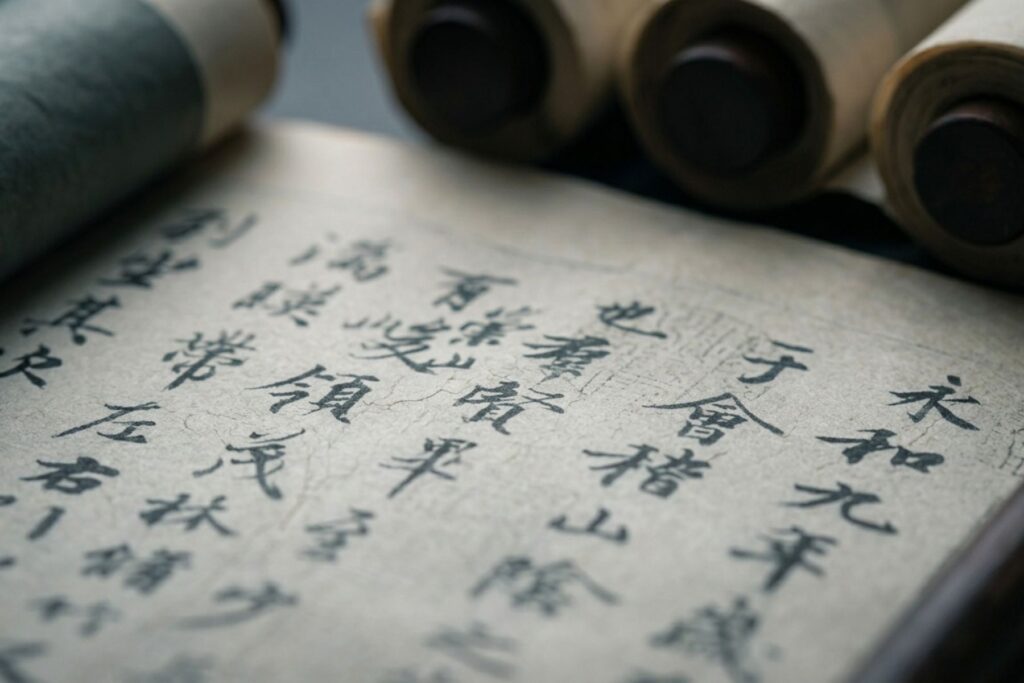
The origins of Chinese writing — and thus of Chinese calligraphy — lie in the ritual practices of the Shang dynasty (c. 1600–1046 BCE). The earliest surviving Chinese inscriptions are found on oracle bones: the shoulder blades of oxen and the plastrons of turtles used by Shang diviners to communicate with ancestral spirits. These oracle bone inscriptions (甲骨文, jiǎgǔwén) exhibit, even at this earliest stage, a concern with formal clarity — each character placed with deliberate spatial intention within its allocated field.
As Chinese civilisation consolidated through the Zhou dynasty (1046–256 BCE), script styles proliferated across the various feudal states, each developing regional variants. The political unification of China under Qin Shi Huang in 221 BCE brought with it the standardisation of script — the imposition of a single official writing system, Small Seal Script (篆書, zhuànshū), across the empire. This act of political unification through shared writing was foundational: it established the written character as the primary medium of Chinese cultural identity, transcending the spoken languages of an extraordinarily diverse population.
The Han dynasty (206 BCE–220 CE) saw the emergence of Clerical Script, a more practical form suited to the demands of administration, and the beginnings of a serious aesthetic discourse around writing. By the time of the Wei and Jin dynasties (220–420 CE), calligraphy had been fully constituted as an art in its own right, with named masters, critical vocabularies, and a tradition of connoisseurship. The figure of Wang Xizhi, working in the fourth century CE, marks the moment at which calligraphy becomes fully conscious of itself as a discipline — and as a measure of human excellence.
The Tang dynasty (618–907 CE) is widely regarded as calligraphy’s first golden age — a period in which imperial patronage, extensive manuscript culture, and a highly developed critical tradition produced masters of towering achievement. The Song dynasty (960–1279 CE) brought a significant shift in emphasis: the great Song literati argued that calligraphy should express individual character and cultivated sensibility above technical rule-following — a position that reoriented the art toward personal expression and has remained influential ever since.
The Scripts
Five Traditions of the Brush: The Classical Script Styles
Chinese calligraphy is conventionally organised around five principal script styles, each with its own historical development, formal characteristics, and aesthetic values. These are not merely different ways of writing the same characters — they represent distinct philosophical and aesthetic orientations toward the act of inscription itself.
Oldest Form
Seal Script
篆書
Chinese calligraphy is conventionally organised around five principal script styles, each with its own historical development, formal characteristics, and aesthetic values. These are not merely different ways of writing the same characters — they represent distinct philosophical and aesthetic orientations toward the act of inscription itself.
Han Dynasty
Clerical Script
隸書
Emerging during the Han dynasty as a pragmatic response to the administrative demands of a vast empire, clerical script introduces flat, broad horizontal strokes and the distinctive “silkworm head and wild goose tail” — a characteristic entry and exit swelling that gives the script its particular visual music. It represents the decisive transition from the archaic to the classical in Chinese graphic culture.
Standard Form
Regular Script
楷書
The script of formal documents, printed texts, and foundational study. Regular script demands the clearest articulation of each stroke in isolation — a discipline that makes it, paradoxically, among the most difficult to perfect. Every structural principle of Chinese character construction is on full display. To master regular script is to understand Chinese writing at its most fundamental.
Semi-Cursive
Running Script
行書
The script of correspondence and personal expression, running script occupies the fertile middle ground between formal legibility and expressive fluency. Strokes connect naturally, characters lean and flow, and the rhythm of the hand becomes audible in the line. It is the most widely practiced form among serious calligraphers and the style in which Wang Xizhi produced his supreme masterwork, the Preface to the Orchid Pavilion
Most Expressive
Cursive Script
草書
The script of correspondence and personal expression, running script occupies the fertile middle ground between formal legibility and expressive fluency. Strokes connect naturally, characters lean and flow, and the rhythm of the hand becomes audible in the line. It is the most widely practiced form among serious calligraphers and the style in which Wang Xizhi produced his supreme masterwork, the Preface to the Orchid Pavilion
Material Culture
The Four Treasures of the Study: Instruments of Cultivation
The material culture of Chinese calligraphy is inseparable from its aesthetic and philosophical character. The instruments of the art — collectively known as the Four Treasures of the Study (文房四寶, wénfáng sìbǎo) — are not merely tools but objects of sustained connoisseurship in their own right. The selection and care of one’s instruments was considered an expression of scholarly character; to possess fine paper, well-prepared ink, a responsively crafted brush, and a stone of excellent texture was to signal the seriousness of one’s commitment to the art.
The Brush
筆 bǐ
The primary instrument of calligraphy, made from animal hair — goat, rabbit, weasel, or wolf — bound to a bamboo or wooden handle. The brush’s capacity for infinite variation in line — thick and thin, wet and dry, fast and slow — is the source of calligraphy’s expressive range. A new brush requires careful preparation; its maintenance demands daily attention. Fine brushes from centres such as Huzhou in Zhejiang province have been prized for centuries.
The Ink
墨 mò
Traditionally supplied in the form of solid sticks — composed of compressed carbon soot and hide glue, often scented and decorated with gold — ink is prepared by the calligrapher through the meditative act of grinding the stick against the wetted inkstone. The rhythm of grinding, the gradual deepening of tone, and the adjustment of consistency are understood as a form of physical and mental preparation for the act of writing. Ink of great age, well-prepared, produces a depth and warmth of black that no modern substitute replicates.
The Paper
硯 yàn
Carved from fine-grained stone — the Duan stones of Guangdong and She stones of Anhui are most celebrated — the inkstone provides both the grinding surface and the ink pool. An exceptional inkstone is smooth enough to grind ink finely without scratching it, yet minutely textured enough to abrade the ink stick effectively. Old inkstones, seasoned by decades of use and darkened by accumulated pigment, are among the most valued objects in Chinese scholarly culture, passed between generations as marks of intellectual inheritance.
Technique & Principles
The Discipline of the Brush: Technique as Cultivated Practice
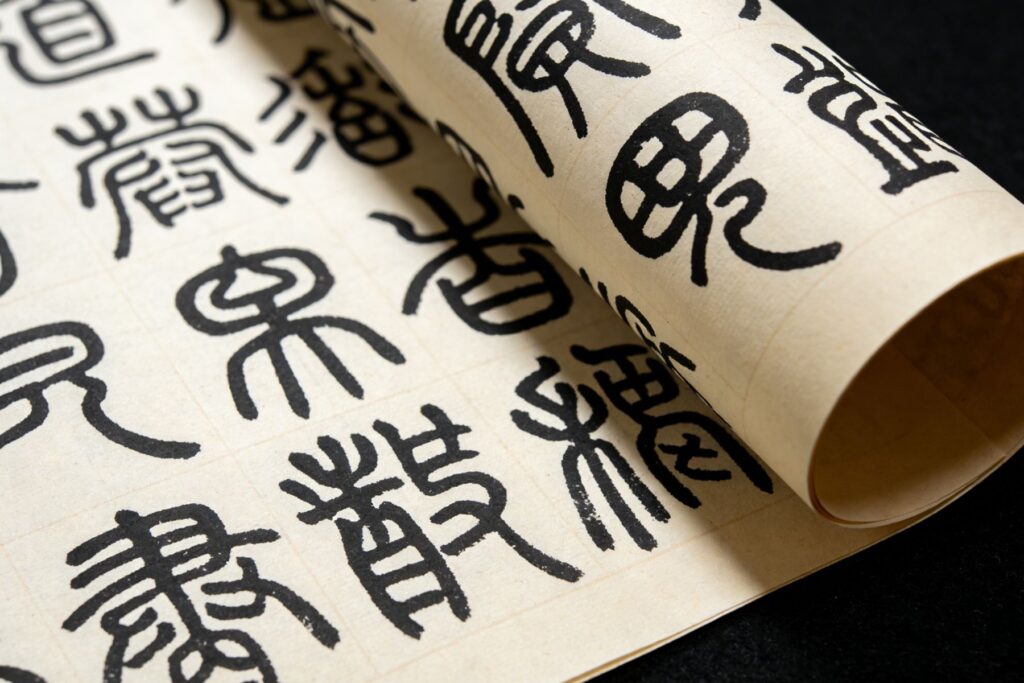
Ancient whispers in Small Seal Script. Tracing the origins of ‘The Way’ through the crinkled textures of history.
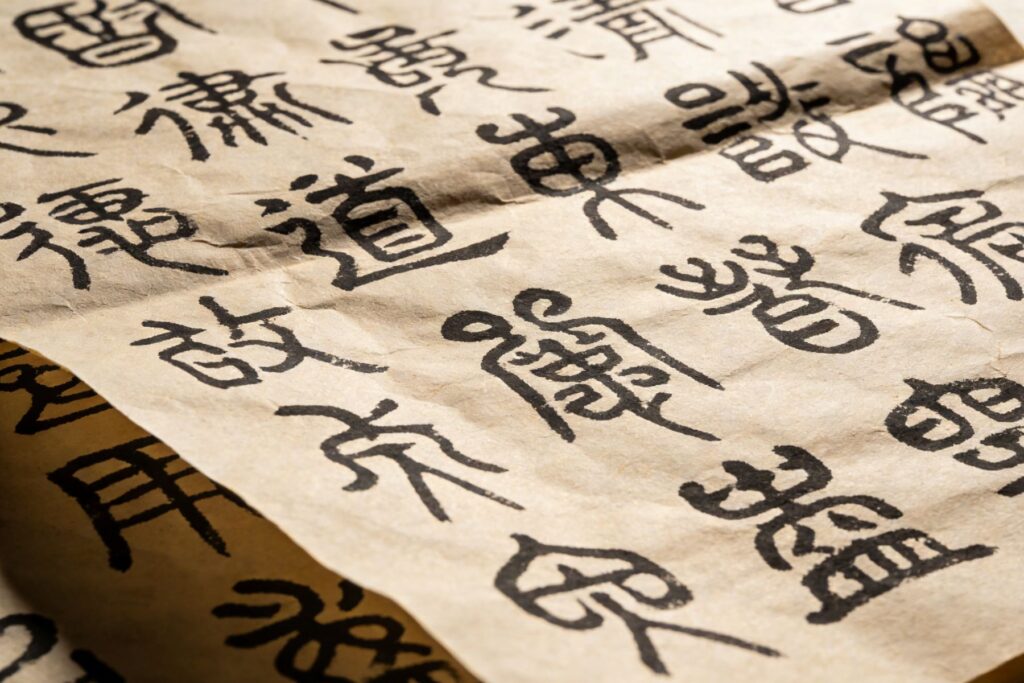
A close-up of traditional Chinese calligraphy written in Seal Script (Zhuanshu, 篆書) on aged, crinkled mulberry or rice paper.
The technical language of Chinese calligraphy is vast and precise, developed over centuries of critical writing and pedagogical transmission. At its foundation are three intersecting mastery domains: control of the brush, command of individual character structure, and the larger compositional intelligence that governs how characters relate to one another across the surface of a work.
Brush control — the most fundamental and most elusive of skills — requires the coordination of grip, wrist, arm, and breath into a single responsive system. The traditional method holds the brush vertically, supported lightly but securely, with the full arm free to move. Pressure determines line weight; speed determines wetness and texture; angle and rotation determine stroke character. These variables, operating simultaneously in real time, produce a line that is as individual as a fingerprint and as legible to the trained eye as a signature.
Character structure — the internal architecture of each written sign — demands a thorough understanding of the eight canonical stroke types, the rules of stroke order, and the spatial logic by which complex characters are assembled from their components. A single character may contain twenty or more strokes, each of which must be executed in a prescribed sequence, at a prescribed speed, with prescribed spatial relationships to what precedes and follows it.
Composition — the arrangement of characters across the page, column, or scroll — brings a further dimension of spatial intelligence. The traditional vertical column format, read from top to bottom and right to left, imposes its own rhythmic demands. The calligrapher must maintain consistent column width and character spacing while allowing the natural variations in brushwork that give a piece life. The relationship between filled and empty space — between the weight of ink and the breath of white — is the highest compositional art.
It is for these reasons that serious calligraphic study requires years, often decades, of daily practice. The goal is not merely to reproduce approved forms but to internalise them so completely that they become available to spontaneous, unreflective expression — the calligraphic equivalent of playing music by ear, on the highest level.
Historical Masters
The Masters of the Tradition: A Selective Canon
Chinese calligraphic culture is organised, in part, around a canon of exemplary masters whose works have been studied, copied, and venerated for centuries. To learn calligraphy is, in the first instance, to enter into a direct physical relationship with these figures — to trace their strokes, to inhabit their rhythms, to understand from the inside what made their work transformative.
303–361 CE · Eastern Jin Dynasty
Wang Xizhi 王羲之
Universally regarded as the supreme figure in Chinese calligraphic history, Wang Xizhi is known as the Sage of Calligraphy (書聖). His masterwork, the Preface to the Orchid Pavilion (蘭亭序), written at a celebrated gathering of literati in 353 CE, is considered the finest example of running script ever produced. The original was famously buried with the Tang emperor Taizong, who obtained it through a ruse — no authentic original survives, only Tang-dynasty tracings. Yet those copies alone sufficed to establish the standard for all subsequent calligraphic practice.
709–785 CE · Tang Dynasty
Yan Zhenqing 顏真卿
The Tang dynasty’s greatest master of regular script, Yan Zhenqing combined structural solidity with an unusual muscularity and moral gravitas that critics found inseparable from his character. A loyal official who died in service to the dynasty rather than submit to a rebel commander, his personal history lent his brushwork a posthumous moral authority. His Duobao Pagoda Stele and Yan Family Temple Stele remain among the most copied works in the calligraphic canon.
737–799 CE · Tang Dynasty
Huai Su 懷素
The supreme practitioner of “wild cursive” (狂草), Huai Su was a Buddhist monk whose cursive scrolls describe a state of near-ecstatic creative energy. Accounts of his practice describe him writing on banana leaves when paper ran short and continuing by lamplight through the night. His Autobiography scroll, preserved in the National Palace Museum in Taipei, is among the most viscerally exciting works in the entire calligraphic tradition — a record of physical and creative liberation made permanent in ink.
1037–1101 CE · Song Dynasty
Su Shi 蘇軾
One of the most complete literary and artistic figures in Chinese cultural history — poet, painter, philosopher, statesman, gastronome — Su Shi’s calligraphy embodies the Song literati ideal of personal expression as the highest artistic value. His brushwork is deliberately idiosyncratic: heavy, tilted, irregular in spacing, and entirely unmistakable. He argued that in calligraphy as in poetry, the authentic expression of a cultivated individual mind matters more than adherence to received models — a position that reoriented the art’s entire philosophical direction.
Cultural Transmission
Beyond China's Borders: The Calligraphic Traditions of East Asia
The influence of Chinese calligraphy on the broader East Asian world is among the most consequential cultural transmissions in human history. As Chinese writing, literature, and administrative culture spread to the Korean peninsula, the Japanese archipelago, and mainland Southeast Asia, Chinese calligraphic practice and aesthetics followed — adopted, adapted, and ultimately transformed into distinctly local traditions of great originality.
Japan Shodō · 書道
Japanese calligraphy — the “Way of Writing” — absorbed Chinese models from the 6th century onward, developing distinctive scripts for the phonetic syllabaries of hiragana and katakana alongside the inherited Chinese characters. The Japanese Zen tradition brought its own aesthetic intensification to the art, valorising spontaneity, incompleteness, and the single expressive mark.
Korea Seoye · 서예
Korean calligraphy developed under close Chinese influence through the Three Kingdoms period and beyond, producing masters of classical Chinese script of the highest order. With the invention of the Hangul phonetic alphabet in the 15th century, Korean calligraphy developed a parallel tradition for the indigenous script — one of the world’s most elegant writing systems — while continuing to cultivate Chinese character writing.
Vietnam Thư Pháp
Vietnamese calligraphy was practiced for centuries in Chinese characters and the indigenous Chữ Nôm script adapted from them. The colonial imposition of a Romanised script in the 19th and 20th centuries created a rupture in this tradition, though Vietnamese calligraphy endures as a living cultural practice — particularly in the production of festival couplets and ceremonial inscriptions.
Contemporary Practice
A Living Art: Calligraphy in the Modern World
The advent of mechanical printing, typefaces, digital text, and keyboard input has not ended Chinese calligraphy — it has clarified its meaning. In a world where the act of handwriting has become largely optional, the deliberate cultivation of calligraphic skill signals a commitment to a set of values that modernity tends to erode: patience, embodied attention, transmission through physical practice, and the conviction that beauty in execution is worth pursuing for its own sake.
In China, calligraphy remains part of school education and is practiced widely as a form of personal cultivation and meditative discipline. Major calligraphic competitions attract thousands of participants annually; exhibitions of both classical and contemporary calligraphic work are a staple of museum programming. State-level recognition of calligraphy as an intangible cultural heritage has reinforced institutional support for its preservation and transmission.
Contemporary calligraphic artists navigate a complex terrain. Some work in a strictly classical mode, dedicating their practice to the deepest possible inhabitation of traditional script styles. Others engage directly with the visual language of modern and contemporary art — treating the calligraphic line as raw material for abstraction, installation, and cross-disciplinary experiment. The most compelling figures hold both impulses simultaneously: rooted in tradition while genuinely open to the present.
Internationally, interest in Chinese calligraphy has grown steadily among both scholarly communities and general audiences drawn to a practice that offers, in the age of digital distraction, an unusually direct encounter with the physical act of making a mark with intention, on paper, in time.